- Involving Social Bigwigs - At the League of Independent Theater's Get Lit with LIT event, the New York State Council of the Arts' Director of Theater Robert Zuckerman (a good person to know) talked about strategies for getting politicians to notice what we do. He talked about a group in the Bronx (I can't remember their names -- sorry!) that have a Politicians' Amateur Night, basically a talent show for politicians. No matter how terrible the politicians are, it gets them visibly involved in arts--and Zuckerman observed that it also gets their lobbyist friends butts in the seats. Stemming from that, I would suggest that arts groups try to get comp tickets into the hands of politicos and maybe other important social heads. After all, there's no better "application" for support than having them enjoy your work.
- Instant Reviews - The post that used the phrase Guyyedwabian was actually about a South African group's attempt to start conversation in the immediate aftermath of a performance. Basically, they attended the National Arts Festival in Grahamstown, and afterwards tried to engage the exiting audience in a review directly after the performance. The concept is outlined here, and an informative post-mortem is outlined here. (By the way, does your organization perform post-project post-mortems? You really should.)
Showing posts with label politics. Show all posts
Showing posts with label politics. Show all posts
Monday, August 17, 2009
Solutions II: Addendum
I knew that the moment I walked away from the post I'd feel compelled to add a few that didn't come straight to mind (hence the need for the list in the first place!)


Monday, December 8, 2008
A Quick Note On Caroline Kennedy, Jeb Bush, Beau Biden
In a word: No.
Ms. Kennedy is a recent inductee in the world of politics; she has not held a legislative branch position. Mr. Bush is a little more understandable; he was the (strangely) popular Governor of Florida--I wouldn't vote for him, but he at least is sort of qualified. But it's an executive branch position. Same goes for Mr. Biden, who was an Attorney General and is currently serving in Iraq.
None of these people have served in the legislative branch. The Senate is not just "a legislative position"; it's the highest office of legislature in the country. Now, I don't think that's necessarily required. But. Would we be considering these people if they weren't in a wealthy family? I think this goes especially for Caroline Kennedy, but the same reservations exist in my mind for Biden and Bush. Kennedy is a third generation political name; Biden and Bush are second generations.
Stop with this madness, before Jenna Bush or Chelsea Clinton run for office.
Ms. Kennedy is a recent inductee in the world of politics; she has not held a legislative branch position. Mr. Bush is a little more understandable; he was the (strangely) popular Governor of Florida--I wouldn't vote for him, but he at least is sort of qualified. But it's an executive branch position. Same goes for Mr. Biden, who was an Attorney General and is currently serving in Iraq.
None of these people have served in the legislative branch. The Senate is not just "a legislative position"; it's the highest office of legislature in the country. Now, I don't think that's necessarily required. But. Would we be considering these people if they weren't in a wealthy family? I think this goes especially for Caroline Kennedy, but the same reservations exist in my mind for Biden and Bush. Kennedy is a third generation political name; Biden and Bush are second generations.
Stop with this madness, before Jenna Bush or Chelsea Clinton run for office.
Sunday, November 2, 2008
Words I'm Sick Of
To refer back to this post of mine, I thought I'd toss together a quick list of phrases that have become meaningless, jingoistic phrases that, after November 4th, I'd like to have disappear.
1) _______ We Can Believe In.
2) Redistribution of wealth.
3) Socialism.
4) [name] the [occupation].
5) Maverick.
6) Real America.
7) Main street / wall street.
8) Ya know.
You can toss those in the bin with Mission Accomplished. I'll add to this list as more occur to me. I just... I want it to stop.
Good lord, I hope William Safire is willing to update his political dictionary.
1) _______ We Can Believe In.
2) Redistribution of wealth.
3) Socialism.
4) [name] the [occupation].
5) Maverick.
6) Real America.
7) Main street / wall street.
8) Ya know.
You can toss those in the bin with Mission Accomplished. I'll add to this list as more occur to me. I just... I want it to stop.
Good lord, I hope William Safire is willing to update his political dictionary.
Saturday, November 1, 2008
2008: Election
I'm going to write it down right now, just to see how my predictions stack up. You can all mock me as these predictions turn out not to be soon.
FEDERAL ELECTIONS:
Presidency: Obama
VP: Biden
Obama selects cabinet:
Secretary of Defense: Robert Gates (or Wesley Clark, but not likely)
Secretary of State: Bill Richardson (or Colin Powell, but not likely)
Secretary of Homeland Security: Richard Clarke
Secretary of the Treasury: Warren Buffet (or somebody we've never heard of)
Attorney General: Patrick Fitzgerald (or Cuomo, but not likely)
The rest of the cabinet will be nobody we've ever heard of. I don't think Hilary Clinton's going to make an appearance.
Federal Reserve Board Chairman: Dan Bernanke remains
UN Ambassador: Somebody we've never heard of, or possibly Richardson if he doesn't get State.
CONGRESSIONAL ELECTIONS:
House: Dems: 350 Seats
Senate: Dems: 55 seats (not counting Bernie Sanders or Joe Lieberman)
JUDICIARY
No appointments in the first term of Presidency.
CALIFORNIA:
PROP 8 Fails (but by a terrifyingly narrow margin)
PROP 1A [High Speed Rail] Succeeds
NEW YORK:
Federal Justice Department blocks term limit lengthening Bloomberg's term. Sucks to be him. Christine Quinn does not win the primary to run to replace him. This may just be wishfulfilment on my part.
2012: These predictions on my part are sketchier. It depends on the leadership of the Republican Party after this election. My guess is that RNCC Chair Mike Duncan is going to be forced to step down after this disastrous election. Now, the RNCC Chairmanship is selected by the Republican President, or by the association of state party chairs; depending on who winds up selecting the new RNCC Chairmanship, it might have different results.
My hunch: Sarah Palin emerges as party chair of a party that's tacking even further to the right, but in 2012 Mike Huckabee wins over the nomination by appealing to the same right-wing values that Palin has tapped into in a manner not seen to be as self-destructive.
(UPDATE: I originally posted this on my Facebook, and decided to put it over here. In the meantime between my posting that there and posting it here, I suddenly realized that I had forgotten an important name in my considerations of Obama's cabinet--Holbrooke! I'm not going to change the prediction, but I really should have remembered that Holbrooke is almost certainly going to feature in the foreign policy. Also, while I'm at it, I should point out that while I didn't mention this before, I think that John McCain will not stand for re-election in 2010. In the off-chance that he is bloody-minded enough to run, I don't think he'll make it. Right now, he's on the verge of losing the Presidential election in his own home state.)
FEDERAL ELECTIONS:
Presidency: Obama
VP: Biden
Obama selects cabinet:
Secretary of Defense: Robert Gates (or Wesley Clark, but not likely)
Secretary of State: Bill Richardson (or Colin Powell, but not likely)
Secretary of Homeland Security: Richard Clarke
Secretary of the Treasury: Warren Buffet (or somebody we've never heard of)
Attorney General: Patrick Fitzgerald (or Cuomo, but not likely)
The rest of the cabinet will be nobody we've ever heard of. I don't think Hilary Clinton's going to make an appearance.
Federal Reserve Board Chairman: Dan Bernanke remains
UN Ambassador: Somebody we've never heard of, or possibly Richardson if he doesn't get State.
CONGRESSIONAL ELECTIONS:
House: Dems: 350 Seats
Senate: Dems: 55 seats (not counting Bernie Sanders or Joe Lieberman)
JUDICIARY
No appointments in the first term of Presidency.
CALIFORNIA:
PROP 8 Fails (but by a terrifyingly narrow margin)
PROP 1A [High Speed Rail] Succeeds
NEW YORK:
Federal Justice Department blocks term limit lengthening Bloomberg's term. Sucks to be him. Christine Quinn does not win the primary to run to replace him. This may just be wishfulfilment on my part.
2012: These predictions on my part are sketchier. It depends on the leadership of the Republican Party after this election. My guess is that RNCC Chair Mike Duncan is going to be forced to step down after this disastrous election. Now, the RNCC Chairmanship is selected by the Republican President, or by the association of state party chairs; depending on who winds up selecting the new RNCC Chairmanship, it might have different results.
My hunch: Sarah Palin emerges as party chair of a party that's tacking even further to the right, but in 2012 Mike Huckabee wins over the nomination by appealing to the same right-wing values that Palin has tapped into in a manner not seen to be as self-destructive.
(UPDATE: I originally posted this on my Facebook, and decided to put it over here. In the meantime between my posting that there and posting it here, I suddenly realized that I had forgotten an important name in my considerations of Obama's cabinet--Holbrooke! I'm not going to change the prediction, but I really should have remembered that Holbrooke is almost certainly going to feature in the foreign policy. Also, while I'm at it, I should point out that while I didn't mention this before, I think that John McCain will not stand for re-election in 2010. In the off-chance that he is bloody-minded enough to run, I don't think he'll make it. Right now, he's on the verge of losing the Presidential election in his own home state.)
Tuesday, September 30, 2008
Conversationalism + 2008: On The Street Where You Live
Yet even as we speak, there are those who are preparing to divide us, the spin masters and negative ad peddlers who embrace the politics of anything goes. Well, I say to them tonight, there's not a liberal America and a conservative America - there's the United States of America. There's not a black America and white America and Latino America and Asian America; there's the United States of America. The pundits like to slice-and-dice our country into Red States and Blue States; Red States for Republicans, Blue States for Democrats. But I've got news for them, too. We worship an awesome God in the Blue States, and we don't like federal agents poking around our libraries in the Red States. We coach Little League in the Blue States and have gay friends in the Red States. There are patriots who opposed the war in Iraq and patriots who supported it. We are one people, all of us pledging allegiance to the stars and stripes, all of us defending the United States of America.
This is the paragraph, in 2004, that turned me into an ardent Barack Obama supporter. It was a promise that there was an idea of America separate from party politics. And a rejection of the cutting and dicing of America. It contrasted sharply with another political candidate of the time:
Today, under George W. Bush, there are two Americas, not one: One America that does the work, another that reaps the reward. One America that pays the taxes, another America that gets the tax breaks. One America - middle-class America - whose needs Washington has long forgotten, another America - narrow-interest America - whose every wish is Washington's command. One America that is struggling to get by, another America that can buy anything it wants, even a Congress and a president.
This is an older meme, but it gained equal traction when John Edwards deployed in 2004. Like the Obama view of America, it unites people regardless of ideology--but unlike Obama, it still creates a huge division in America. The "narrow-interest" America versus the "middle-class" America. It harkens back to How The Other Half Lives. But it's still a politics of division. A politics of the enemy. The rich, entitled (bourgeois?) versus the everyday, ethical man.
In 2008, it reared its head again not just in the visage of John Edwards (still under the Two Americas name), but under Mike Huckabee:
I'm not a Wall Street Republican, I'm a Main Street Republican.
Perhaps a testament to the lasting influence of Huckabee is that now, during this economic crisis, you literally cannot open your mouth to talk about the bailout plan without saying the phrase "It has to work for Main Street, not just for Wall Street."
Even Barack Obama has been using this phrase, which makes me sad. What happened to "These United States of America?" Certainly, it hasn't been visible in Nancy Pelosi's "leadership," which most recently consisted of blaming House Republicans for this mess. That doesn't mean that House Republicans don't share the blame--the point is that we're not even talking about the issues, the solutions, or reality.
Instead, we're trumping up this economic division. Is everyone in the financial industry evil? Maybe the CEOs and the Investment Branches. But I have several close friends who work as bank tellers. You know who suffers if Washington Mutual or Wachovia branches close? They do. I agree that there have to be strings attached, etc. etc., but if we start employing the language of a culture war, we start setting our priorities incorrectly: our priority is not to punish the financial industry, or to find blame. Our priority is to straighten out the markets.
We can start creating accountability, rewriting the legislations, straightening things out after we've guaranteed that our inaction hasn't caused a 700 point in the DOW Jones. Just to reiterate: the stock market is not just for rich speculators: people have their savings there. Banks are not just for rich speculators: people have their savings in there.
Notice: when Americans are asked how they feel about the bailout, they react strongly against it. When they are asked how they feel about a rescue package that has exactly the same terms as the bailout but isn't called a bailout, they react strongly in favor.
And what this really boils down to is: why are we using any of the language of politics right now? Why are we debating "Wall Street" and "Main Street"? In fact, why are our Congresspeople publicly debating the Bailout package? They should be in meetings, privately debating the bailout package. This is the moment for Congress to quickly and quietly get to its work.
I don't mean that it should be secret--Congresspeople should keep the American public informed as to how the package is going, and once an agreement has been reached, it should be presented to the public. All I'm saying is that trying to play the political game at the same time as the statesman game is going to hold us back.
All I can do is remind you: we have no red states, or blue states: only these United States. There isn't a Rich Person's Economy and a Poor Person's Economy: there's the World Economy. When you find it more important to debate whether the free market solves everything, or to vilify the very House Republicans whose support you need to pass this bill, not only are you watching the US market decline, but the Eastern market, the European markets. Everyone hurts.
Monday, September 15, 2008
Hard Sexism Vs. Soft Sexism
Racism and sexism are emotional issues. Everyone interprets them differently, even within the groups which are affected. I recall a time in one of my classes when, attempting to create a work about gender issues, I chose to use the song "My Humps" by Black Eyed Peas. Asked why I used "My Humps", I responded (rather off-handedly) because it seemed like the most anti-feminist song I could find. Of course, I'm sure that the young lady who sings that song does not agree, but I had assumed that she, like many young women, had been trained to give men what they want, to enable objectification.
My brief analysis (I didn't go very far into it because I'd hit a nerve with a number of women, and it's not my intention to do so) was debated for a long time by many of the women in the class (the men had the sense, overall, to keep their mouths shut). Half of the women in the class believed that the song was about female empowerment; a woman getting men to serve her, to attend to her needs (material and sexual) as she pleases, putting her in a position of power. The other half were of the opinion that the blatant objectification that the young woman subjects herself to denies her any sort of respect or equal standing with men; they may think she's special, but only as an object.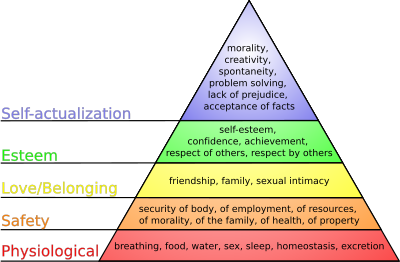
I agree with the the latter argument, because of Maslow's Heirarchy of Needs, (which I agree with), which would show that she's giving up self-actualization/esteem/love+belonging in the long run for physiological in the short run.
At any rate, what this discussion proved to me is that there is no one definition as to what is sexist and what isn't sexist, and that things that are seen as empowerment from one angle can actually be demeaning from another angle.
I discussed hard and soft racism in the last post, and you can basically substitute hard and soft sexism (or hard and soft homophobia) here. Hard sexism is an ideology that women are inferior; soft sexism is an attitude or action which demonstrates negative attitudes or associations with regard to women.
Since I covered this exhaustively in the last post, I'm just going to say something more briefly about hard/soft sexism: I believe Sarah Palin's nomination is soft sexism.
The reason is this: there are many, many qualified women in this country. Even among Republicans. Kate Fiorina, the CEO of HP. Condoleeza Rice (since apparently Bush's policy isn't discredited, as I had previously thought). Senator Olympia Snow. A controversial pick might be Democratic governor Cathleen Selebius, who I had considered a possible candidate for Obama's political ticket.
But even if Sarah Palin was the best woman that could have been chosen, she would have had to be vetted. The fact that McCain waltzed in, decided to pick a woman he'd spoken to once as his VP, and assumed that this would endear him to the women of the country is insulting. And that's what I mean by soft racism. I don't think McCain thinks women are inherently bad. But he clearly doesn't take them seriously enough.
My brief analysis (I didn't go very far into it because I'd hit a nerve with a number of women, and it's not my intention to do so) was debated for a long time by many of the women in the class (the men had the sense, overall, to keep their mouths shut). Half of the women in the class believed that the song was about female empowerment; a woman getting men to serve her, to attend to her needs (material and sexual) as she pleases, putting her in a position of power. The other half were of the opinion that the blatant objectification that the young woman subjects herself to denies her any sort of respect or equal standing with men; they may think she's special, but only as an object.
I agree with the the latter argument, because of Maslow's Heirarchy of Needs, (which I agree with), which would show that she's giving up self-actualization/esteem/love+belonging in the long run for physiological in the short run.
At any rate, what this discussion proved to me is that there is no one definition as to what is sexist and what isn't sexist, and that things that are seen as empowerment from one angle can actually be demeaning from another angle.
I discussed hard and soft racism in the last post, and you can basically substitute hard and soft sexism (or hard and soft homophobia) here. Hard sexism is an ideology that women are inferior; soft sexism is an attitude or action which demonstrates negative attitudes or associations with regard to women.
Since I covered this exhaustively in the last post, I'm just going to say something more briefly about hard/soft sexism: I believe Sarah Palin's nomination is soft sexism.
The reason is this: there are many, many qualified women in this country. Even among Republicans. Kate Fiorina, the CEO of HP. Condoleeza Rice (since apparently Bush's policy isn't discredited, as I had previously thought). Senator Olympia Snow. A controversial pick might be Democratic governor Cathleen Selebius, who I had considered a possible candidate for Obama's political ticket.
But even if Sarah Palin was the best woman that could have been chosen, she would have had to be vetted. The fact that McCain waltzed in, decided to pick a woman he'd spoken to once as his VP, and assumed that this would endear him to the women of the country is insulting. And that's what I mean by soft racism. I don't think McCain thinks women are inherently bad. But he clearly doesn't take them seriously enough.
Hard Racism vs. Soft Racism
Our language has simplified over the last generation. Simplified language often leads to simplified thought: thought is, after all, encoded in the logic of language.
So when two phenomenon share the same word, confusion may arise when multiple people misinterpret the same word to mean different things.
This applies to various "isms;" racism, sexisim, ageism, and homophobia (it doesn't end in ism but it's the same sort of sentiment). We use the term racism carefully in this country. But we also throw it around a lot. We have a lot of anxiety about what's termed "racist" and what is not termed "racist." People who use it too much devalue the word; people who use it too little let racists get away with defamation. I'm going to focus on racism right now because Barack Obama invited this nation to have a dialog about race (which has not been followed up on), but this can be applied to sexism as well--that installment is coming soon.
So let me begin by splitting the term 'racism' into two categories: "hard" racism and "soft" racism. Hard racism is a very plain sort of racism, and thus we don't hear it spoken aloud anymore. Ever since the Civil Rights Movement, our culture has decided, as a majority, that it is unacceptable to be a hard racist aloud anymore. This isn't to say that there aren't hard racists; but whenever a statement that is hard racism is heard aloud, that person is pretty much chased out of any public position they might hold.
"Hard" racism is an extreme form of racism. "Hard" racism is holding the belief that one or more races are inferior to one or more races. Adolf Hitler was a hard racist. Racial eugenicists are hard racists. Jim Crow Laws are hard racist laws. They codify the notion that one race of people is objectively (in their eyes) worse than another race of people. People who speak hard racism aloud are tagged, unequivocally, as bigots.
Today, we don't see nearly as much of that. But what we do see is a lot more of "soft" racism. "Soft" racism is hard to define. "Soft" racism is non-absolute; it does not hold that one race is absolutely worse than another. But it has a lot of negative connections with a race. One type of soft racism is ignorance. Another sort of soft racism is resentment.
Barack Obama, in his speech about race, talked about "white resentment," caused by pro-minority actions such as Affirmative Action. It is unsurprising that if one group gets preferential treatment, there will be resentment by the other. And these resentful emotions will spill over into negative attitudes. A hostility; an avoidance.
Now, these people who feel resentment toward African Americans may say that they do not think African Americans are worse, as race. Most probably genuinely believe that. But they do still feel a racial tension which cannot be dismissed as being completely non-racist. And this racial tension, or negative attitude toward African Americans may manifest itself in negative action. And that negative action will be racist, no matter how you dice it.
If both "soft" and "hard" racism are still racisms, why is it important to distinguish? Because soft racism can usually be bridged by better communication, more cooperation, and more information. For instance: affirmative action is only necessary in a community which acknowledges that all of its poor will not get opportunities to education. If a leader brings the white community and the black and latino and asian and etc. communities to work together to improve the opportunities of college education to everyone, then the resentment will decrease.
Hard racism has to be fought. I remain highly doubtful that the Jim Crow laws and segregation could have been ended simply by having Martin Luther King Jr. and Strom Thurmond sitting at a table discussion solutions. Strom Thurmond's belief that the black man was inferior was an ideology; it was entrenched in how he approached the world. And we have no need to give that any time or respect.
The reason is because "hard" racism is an ideology of racism and "soft" racism are facets or actions of racism; the latter being bad, but not as all-encompassing as the first.
Another reason "soft" racism needs to be addressed is that it often causes subconscious soft racism. People who are nervous when black men approach them in the street are exhibiting racism in a way, but it would be ridiculous to put that in the same class as joining the Klu Klux Klan. The imagery and the stereotypes and the cultures which give rise to these soft racisms need to be addressed. They cannot be ignored.
For instance, in the Amadu Dialo case, the officers involved had an ingrained soft-racism; their assumptions were that a black man of a certain age might be violent. And because of it, their reflexes (in under seven seconds; a core part of Malcolm Gladwell's book Blink) led them to shoot a man over 40 times before they could accurately and dispassionately appraise the situation. Do I think they were hard racist--that they think the black man is inferior? No, I don't believe that. But I do believe that they were soft racists; taught to expect trouble from men of a certain description. And although I have only met a few hard racists, I have barely met anyone who doesn't exhibit the occasional sign of "soft-racism" (Exhibit A: "Everyone's A Little Bit Racist" from Avenue Q).
It is important to confront these soft-racisms and make everyone aware when they are going on. Because the conscious mind can overcome subconscious soft-racism, and the conscious mind can address the causes of soft-racism. Unquestioned, they might simply fester, and lead to those cases of hard racism that we want to avoid.
And one last notice: hard racism nowadays masquerades as soft racism; sometimes it is barely detectable. This makes it hard to point to. For instance, I personally detect a hint of hard racism about the McCain campaign's allegation of Obama as "presumptuous" (David Gergen, a Southerner, called it a code-word that everyone in the South would recognize as standing in for uppity). But of course I wouldn't be able to prove it, any more than I can prove that Obama's "out of touch" ad is ageist, the way the McCain campaign alleges it is. When Trent Lott famously said that if they'd elected Strom Thurmond, we wouldn't be in "this mess," did he actually mean that we should have a segregationalist country? It seems pretty clear to me and to most people, but because of this conflation of hard and soft racism, it loses its impact.
Be on the lookout, America.
So when two phenomenon share the same word, confusion may arise when multiple people misinterpret the same word to mean different things.
This applies to various "isms;" racism, sexisim, ageism, and homophobia (it doesn't end in ism but it's the same sort of sentiment). We use the term racism carefully in this country. But we also throw it around a lot. We have a lot of anxiety about what's termed "racist" and what is not termed "racist." People who use it too much devalue the word; people who use it too little let racists get away with defamation. I'm going to focus on racism right now because Barack Obama invited this nation to have a dialog about race (which has not been followed up on), but this can be applied to sexism as well--that installment is coming soon.
So let me begin by splitting the term 'racism' into two categories: "hard" racism and "soft" racism. Hard racism is a very plain sort of racism, and thus we don't hear it spoken aloud anymore. Ever since the Civil Rights Movement, our culture has decided, as a majority, that it is unacceptable to be a hard racist aloud anymore. This isn't to say that there aren't hard racists; but whenever a statement that is hard racism is heard aloud, that person is pretty much chased out of any public position they might hold.
"Hard" racism is an extreme form of racism. "Hard" racism is holding the belief that one or more races are inferior to one or more races. Adolf Hitler was a hard racist. Racial eugenicists are hard racists. Jim Crow Laws are hard racist laws. They codify the notion that one race of people is objectively (in their eyes) worse than another race of people. People who speak hard racism aloud are tagged, unequivocally, as bigots.
Today, we don't see nearly as much of that. But what we do see is a lot more of "soft" racism. "Soft" racism is hard to define. "Soft" racism is non-absolute; it does not hold that one race is absolutely worse than another. But it has a lot of negative connections with a race. One type of soft racism is ignorance. Another sort of soft racism is resentment.
Barack Obama, in his speech about race, talked about "white resentment," caused by pro-minority actions such as Affirmative Action. It is unsurprising that if one group gets preferential treatment, there will be resentment by the other. And these resentful emotions will spill over into negative attitudes. A hostility; an avoidance.
Now, these people who feel resentment toward African Americans may say that they do not think African Americans are worse, as race. Most probably genuinely believe that. But they do still feel a racial tension which cannot be dismissed as being completely non-racist. And this racial tension, or negative attitude toward African Americans may manifest itself in negative action. And that negative action will be racist, no matter how you dice it.
If both "soft" and "hard" racism are still racisms, why is it important to distinguish? Because soft racism can usually be bridged by better communication, more cooperation, and more information. For instance: affirmative action is only necessary in a community which acknowledges that all of its poor will not get opportunities to education. If a leader brings the white community and the black and latino and asian and etc. communities to work together to improve the opportunities of college education to everyone, then the resentment will decrease.
Hard racism has to be fought. I remain highly doubtful that the Jim Crow laws and segregation could have been ended simply by having Martin Luther King Jr. and Strom Thurmond sitting at a table discussion solutions. Strom Thurmond's belief that the black man was inferior was an ideology; it was entrenched in how he approached the world. And we have no need to give that any time or respect.
The reason is because "hard" racism is an ideology of racism and "soft" racism are facets or actions of racism; the latter being bad, but not as all-encompassing as the first.
Another reason "soft" racism needs to be addressed is that it often causes subconscious soft racism. People who are nervous when black men approach them in the street are exhibiting racism in a way, but it would be ridiculous to put that in the same class as joining the Klu Klux Klan. The imagery and the stereotypes and the cultures which give rise to these soft racisms need to be addressed. They cannot be ignored.
For instance, in the Amadu Dialo case, the officers involved had an ingrained soft-racism; their assumptions were that a black man of a certain age might be violent. And because of it, their reflexes (in under seven seconds; a core part of Malcolm Gladwell's book Blink) led them to shoot a man over 40 times before they could accurately and dispassionately appraise the situation. Do I think they were hard racist--that they think the black man is inferior? No, I don't believe that. But I do believe that they were soft racists; taught to expect trouble from men of a certain description. And although I have only met a few hard racists, I have barely met anyone who doesn't exhibit the occasional sign of "soft-racism" (Exhibit A: "Everyone's A Little Bit Racist" from Avenue Q).
It is important to confront these soft-racisms and make everyone aware when they are going on. Because the conscious mind can overcome subconscious soft-racism, and the conscious mind can address the causes of soft-racism. Unquestioned, they might simply fester, and lead to those cases of hard racism that we want to avoid.
And one last notice: hard racism nowadays masquerades as soft racism; sometimes it is barely detectable. This makes it hard to point to. For instance, I personally detect a hint of hard racism about the McCain campaign's allegation of Obama as "presumptuous" (David Gergen, a Southerner, called it a code-word that everyone in the South would recognize as standing in for uppity). But of course I wouldn't be able to prove it, any more than I can prove that Obama's "out of touch" ad is ageist, the way the McCain campaign alleges it is. When Trent Lott famously said that if they'd elected Strom Thurmond, we wouldn't be in "this mess," did he actually mean that we should have a segregationalist country? It seems pretty clear to me and to most people, but because of this conflation of hard and soft racism, it loses its impact.
Be on the lookout, America.
Fear of Unity: Why I'm Disheartened About The Republican Party
Before I begin: I consider myself an independent, but because of my personal beliefs and my more pragmatic approach to politics, I wind up aligned (most of the time) with the Democratic Party.
That being said, I find myself a lot more invested in the Republican party than most Democrats (or fellow-travelers). There's two reasons for this, and they are interlinked.
I am what most people would call a Democrat, but I don't fall lock-step into the party platform. And therefore, although I want there to be Democrats in Congress, I do still want there to be Republicans (or oppositional Democrats, or Independents) which represent issues on which I disagree with the Democrats. For instance: the Democrats have made a lot of issues of change part of their platform, but fiscal responsibility is still not their strongest suit (they're doing better, in my mind, than the Republican Party in general, but it's not the top of their agenda). Between the sum of two or more parties, all of my desires will be represented in the dicussions of Congress.
The second reason, which is tied into the first, is that I don't ever want one party to rule. Even if it's the party I support. Even if it was a party led by Barack Obama, taking completely his words to be law. And believe me, I'm excited about Barack Obama. But I want Obama to feel the opposing force of dedicated, intelligent conservatives. Opponents who will correct the flaws in Obama's policy, and make it better for the criticism.
Which is why right now, I'm disheartened by the Republicans. When I went into Primary Season, I hoped against hope that John McCain would win. Instead, he lost. He may be the nominee, but the ideas and platform that I remember supporting John McCain for got lost. Very early in the primary, my support for him was destroyed.
I want two parties who agree on one single principle: the truth is important. I was fiscal conservatives who agree on the hard truth that we don't have an infinite credit card; I want socialist-leaning candidates who agree on the truth that taking care of the poor is necessary. I want people who can agree that nothing is absolute, and that both sides of the issue merit examination.
I was thrilled that Obama came out on this side, because I believe he believes in the truth, in consistency, in good governance, and in dialogue. And the old John McCain believed in that. The new John McCain hides his VP from the press, lies and lies and lies, hews to whatever opinion is popular, and in general acts with a total disregard of the truth (Harry Frankfurt's definition of Bullshit).
By the end of the primary season, I was rooting for two ponies in the Primary Season. One was Mike Huckabee. Huckabee, to a certain degree, is not my favorite man in the world: I think that his social conservatism is a holdover from an age we should leave behind. I refuse to accept anything less than equal rights for all genders and sexualities. But on the other hand, Huckabee came across as a thinking social conservative. He has always been respectful of Obama (the only one at the Republican Convention with anything nice to say) and of his Republican enemies (at a time when Mitt Romney and Rudy Giuliani were content to question patriotism and adherence to Reagan). I can imagine that if Mike Huckabee were to take the Presidency and the Democrats retain their hold on Congress, social issues might continue to be a mess but things like health-care reform and poverty issues would be able to be discussed in a bipartisan manner. I can't prove, of course, that Mike Huckabee might not get McCained, and I am extremely unhappy at the fact that he (unlike my other pony in the race) was willing to be at the Republican Convention and tout McCain at all.
But I don't believe in vilifying enemies unless they actually are villains, and certainly I think we'd have a healthier national discussion right now if Mike Huckabee was the VP candidate rather than this Sarah Palin character.
The other horse I had in the race is Dr. Ron Paul. Dr. Paul, like Mike Huckabee, attracted a significant base (in many areas, up to 15%, like Huckabee) of people who strongly agreed with him and believed in him personally. Paul, like Huckabee, is not prone to baseless character assassination. Paul, like Huckabee has a sense of humor (which you should never underrate in a politician--a lack of a sense of humor indicates a lack of a sense of perspective).
It is disgraceful of the Republican Party, by the way, that this group simply get ignored and dismissed. No representation in the Republican Convention, unless they want to be sycophantic and fall in step behind John McCain. I suppose it is his party, but what has the party done to appeal to Paul's movement? Considering all of the pandering which goes on toward the evangelicals (such as the Palin nomination).
And who is Dr. Paul's movement fueled by? Dr. Paul speaks to a group that I want more represented in politics: Libertarians. My brother is a Ron Paul libertarian, and we have discussed this at length. One of our debates centered around the Internal Revenue Service, which Dr. Paul wants to get rid of in lieu of a flat sales tax. Now, I disagree with the flat sales tax. On the other hand, Paul wants a simpler, more straightforward, less loophole-prone tax code. Even us big-government socialist Democrats can see the virtue in that, for many reasons (one of which being the fact that a complicated, time-consuming tax code winds up costing the poor and benefiting the rich). There's common ground. We can work together.
Another discussion: healthcare. Now, libertarians, in general, don't believe that everyone should be forced to have healthcare. I suppose I agree with that... if someone is determined that they don't want health insurance, that (I suppose) is their right. Now, if someone wants not to insure their child I'm more against that. One of the points my libertarian brother raised, however, is that the problem isn't that people don't have health-care, it's that healthcare is too expensive for people to have. Therefore, finding out how to lower the price of healthcare and increase its efficiency is the first step. If you lower the price of health insurance, then less people would need help paying for health insurance. And then we can discuss who the government should help in terms of health insurance.
Democrats may be too blinded by their drive for an English-style National Health Service to realize that it is just as important to lower the prices of medical care than to help pay for it. And that's something that I hadn't thought of. Libertarians had. Probably because they have a lot of economists on their side.
Now, I'm unhappy about this upcoming election because the Republican Party still seems rather lock-step behind the Neoconservative movement that I thought had proven itself bankrupt. The problem with neoconservatism isn't necessarily their platform (although certain parts of the platform are extremely unpleasant to me and to people of my political background), it's the ideology of the background. Neoconservatives are not out to govern better. They are out to pass their agenda. Compromise has not been in their history. We need compromise. We need thoughtful conservatives, not ideological conservatives.
I actually feel the same, in reverse, on a state level. My home state of California has a very bankrupt politics as well. If you don't know, a few years ago we had a Governor named Gray Davis. He promised a lot of money for a lot of things during the years when we had a huge surplus, and then the state got defrauded by the energy market he deregulated (read: Enron), the tech bubble boomed, and he rolled back parts of his platform. The state now has ballooning debt, and is governed by Governor Schwarzenegger, who replaced Davis.
The problem with California is two-fold. The major problem is the initiative system. The initiative system is a great system for passing laws, but because of a lack of distinction between laws and government programs, the voters get to directly propose and vote on government programs--in essence, the budget is decided by popular vote. And as you might expect, the California voters continue to vote to spend more money and take in less taxes.
This is a ridiculous situation. Nobody will tell the voters otherwise, because if they do, they'll lose their office immediately. But it is necessary to balance the budget. You cannot run a government with a broken fiscal system, any more than you can run it with a broken political system.
The second problem is the Democratic Party of the State of California. When Gray Davis was being recalled, there was an strange method: on the same ballot was two separate votes:
vote 1: Recall Gray Davis?
vote 2: Who would you like to replace Gray Davis?
The latter vote being dependent on the first being passed. Now, from the perspective of the Democratic Party, they need to run a candidate in the latter. It obviously can't be Gray Davis. Now, common sense would dictate that you should support Gray Davis, and find someone else (plausibly distinct from Davis) to run for vote 2.
Instead, the Democrats ran Bustamante, the Lieutenant Governor, who ran on a platform of "I promise to continue Gray Davis' platform."
Well, that was stupid. Obviously, once the recall passed, a majority of Californians were against continuing Gray Davis' platform. And since the Democrats didn't give them any other option, they got to choose between Schwarzenegger and Ariana Huffington (Independent), or a Republican who was even more conservative than Schwarzenegger). Clearly, Schwarzenegger would win. But this gave poor Schwarzenegger the mistaken idea that he had a mandate to try and balance the budget. And ever since then, he's been at war with the bureaucracy of the state of California, and with the people who supported him.
And it has been several years since then. The only opponent who has come against Schwarzenegger was Phil Angelides (Davis' treasurer), who was just as equally unpopular. He turned out to be a crooked character too. So the question is: why can't we do better, Democrats? Schwarzenegger wants to balance the budget. This is something that needs to be done. Democrats will not win any battles by saying we should continue ridiculous debt spending. Instead, they need to confront Schwarzenegger and say, "Yeah, he wants these things, but we can deliver it. We can negotiate; Schwarzenegger can only threaten."
So until then, I support Governor Schwarzenegger's ridiculous guerilla tactics against the Teacher's Union and the state legislature. Schwarzenegger may not be the best politican we could have asked for, but he's the only one in the state taking things seriously. Where is the Democratic Party? Who else are going to tackle those problems?
We live in a two-party system in this country. That means we need both parties. And the better each party is, the better our country will be.
That being said, I find myself a lot more invested in the Republican party than most Democrats (or fellow-travelers). There's two reasons for this, and they are interlinked.
I am what most people would call a Democrat, but I don't fall lock-step into the party platform. And therefore, although I want there to be Democrats in Congress, I do still want there to be Republicans (or oppositional Democrats, or Independents) which represent issues on which I disagree with the Democrats. For instance: the Democrats have made a lot of issues of change part of their platform, but fiscal responsibility is still not their strongest suit (they're doing better, in my mind, than the Republican Party in general, but it's not the top of their agenda). Between the sum of two or more parties, all of my desires will be represented in the dicussions of Congress.
The second reason, which is tied into the first, is that I don't ever want one party to rule. Even if it's the party I support. Even if it was a party led by Barack Obama, taking completely his words to be law. And believe me, I'm excited about Barack Obama. But I want Obama to feel the opposing force of dedicated, intelligent conservatives. Opponents who will correct the flaws in Obama's policy, and make it better for the criticism.
Which is why right now, I'm disheartened by the Republicans. When I went into Primary Season, I hoped against hope that John McCain would win. Instead, he lost. He may be the nominee, but the ideas and platform that I remember supporting John McCain for got lost. Very early in the primary, my support for him was destroyed.
I want two parties who agree on one single principle: the truth is important. I was fiscal conservatives who agree on the hard truth that we don't have an infinite credit card; I want socialist-leaning candidates who agree on the truth that taking care of the poor is necessary. I want people who can agree that nothing is absolute, and that both sides of the issue merit examination.
I was thrilled that Obama came out on this side, because I believe he believes in the truth, in consistency, in good governance, and in dialogue. And the old John McCain believed in that. The new John McCain hides his VP from the press, lies and lies and lies, hews to whatever opinion is popular, and in general acts with a total disregard of the truth (Harry Frankfurt's definition of Bullshit).
By the end of the primary season, I was rooting for two ponies in the Primary Season. One was Mike Huckabee. Huckabee, to a certain degree, is not my favorite man in the world: I think that his social conservatism is a holdover from an age we should leave behind. I refuse to accept anything less than equal rights for all genders and sexualities. But on the other hand, Huckabee came across as a thinking social conservative. He has always been respectful of Obama (the only one at the Republican Convention with anything nice to say) and of his Republican enemies (at a time when Mitt Romney and Rudy Giuliani were content to question patriotism and adherence to Reagan). I can imagine that if Mike Huckabee were to take the Presidency and the Democrats retain their hold on Congress, social issues might continue to be a mess but things like health-care reform and poverty issues would be able to be discussed in a bipartisan manner. I can't prove, of course, that Mike Huckabee might not get McCained, and I am extremely unhappy at the fact that he (unlike my other pony in the race) was willing to be at the Republican Convention and tout McCain at all.
But I don't believe in vilifying enemies unless they actually are villains, and certainly I think we'd have a healthier national discussion right now if Mike Huckabee was the VP candidate rather than this Sarah Palin character.
The other horse I had in the race is Dr. Ron Paul. Dr. Paul, like Mike Huckabee, attracted a significant base (in many areas, up to 15%, like Huckabee) of people who strongly agreed with him and believed in him personally. Paul, like Huckabee, is not prone to baseless character assassination. Paul, like Huckabee has a sense of humor (which you should never underrate in a politician--a lack of a sense of humor indicates a lack of a sense of perspective).
It is disgraceful of the Republican Party, by the way, that this group simply get ignored and dismissed. No representation in the Republican Convention, unless they want to be sycophantic and fall in step behind John McCain. I suppose it is his party, but what has the party done to appeal to Paul's movement? Considering all of the pandering which goes on toward the evangelicals (such as the Palin nomination).
And who is Dr. Paul's movement fueled by? Dr. Paul speaks to a group that I want more represented in politics: Libertarians. My brother is a Ron Paul libertarian, and we have discussed this at length. One of our debates centered around the Internal Revenue Service, which Dr. Paul wants to get rid of in lieu of a flat sales tax. Now, I disagree with the flat sales tax. On the other hand, Paul wants a simpler, more straightforward, less loophole-prone tax code. Even us big-government socialist Democrats can see the virtue in that, for many reasons (one of which being the fact that a complicated, time-consuming tax code winds up costing the poor and benefiting the rich). There's common ground. We can work together.
Another discussion: healthcare. Now, libertarians, in general, don't believe that everyone should be forced to have healthcare. I suppose I agree with that... if someone is determined that they don't want health insurance, that (I suppose) is their right. Now, if someone wants not to insure their child I'm more against that. One of the points my libertarian brother raised, however, is that the problem isn't that people don't have health-care, it's that healthcare is too expensive for people to have. Therefore, finding out how to lower the price of healthcare and increase its efficiency is the first step. If you lower the price of health insurance, then less people would need help paying for health insurance. And then we can discuss who the government should help in terms of health insurance.
Democrats may be too blinded by their drive for an English-style National Health Service to realize that it is just as important to lower the prices of medical care than to help pay for it. And that's something that I hadn't thought of. Libertarians had. Probably because they have a lot of economists on their side.
Now, I'm unhappy about this upcoming election because the Republican Party still seems rather lock-step behind the Neoconservative movement that I thought had proven itself bankrupt. The problem with neoconservatism isn't necessarily their platform (although certain parts of the platform are extremely unpleasant to me and to people of my political background), it's the ideology of the background. Neoconservatives are not out to govern better. They are out to pass their agenda. Compromise has not been in their history. We need compromise. We need thoughtful conservatives, not ideological conservatives.
I actually feel the same, in reverse, on a state level. My home state of California has a very bankrupt politics as well. If you don't know, a few years ago we had a Governor named Gray Davis. He promised a lot of money for a lot of things during the years when we had a huge surplus, and then the state got defrauded by the energy market he deregulated (read: Enron), the tech bubble boomed, and he rolled back parts of his platform. The state now has ballooning debt, and is governed by Governor Schwarzenegger, who replaced Davis.
The problem with California is two-fold. The major problem is the initiative system. The initiative system is a great system for passing laws, but because of a lack of distinction between laws and government programs, the voters get to directly propose and vote on government programs--in essence, the budget is decided by popular vote. And as you might expect, the California voters continue to vote to spend more money and take in less taxes.
This is a ridiculous situation. Nobody will tell the voters otherwise, because if they do, they'll lose their office immediately. But it is necessary to balance the budget. You cannot run a government with a broken fiscal system, any more than you can run it with a broken political system.
The second problem is the Democratic Party of the State of California. When Gray Davis was being recalled, there was an strange method: on the same ballot was two separate votes:
vote 1: Recall Gray Davis?
vote 2: Who would you like to replace Gray Davis?
The latter vote being dependent on the first being passed. Now, from the perspective of the Democratic Party, they need to run a candidate in the latter. It obviously can't be Gray Davis. Now, common sense would dictate that you should support Gray Davis, and find someone else (plausibly distinct from Davis) to run for vote 2.
Instead, the Democrats ran Bustamante, the Lieutenant Governor, who ran on a platform of "I promise to continue Gray Davis' platform."
Well, that was stupid. Obviously, once the recall passed, a majority of Californians were against continuing Gray Davis' platform. And since the Democrats didn't give them any other option, they got to choose between Schwarzenegger and Ariana Huffington (Independent), or a Republican who was even more conservative than Schwarzenegger). Clearly, Schwarzenegger would win. But this gave poor Schwarzenegger the mistaken idea that he had a mandate to try and balance the budget. And ever since then, he's been at war with the bureaucracy of the state of California, and with the people who supported him.
And it has been several years since then. The only opponent who has come against Schwarzenegger was Phil Angelides (Davis' treasurer), who was just as equally unpopular. He turned out to be a crooked character too. So the question is: why can't we do better, Democrats? Schwarzenegger wants to balance the budget. This is something that needs to be done. Democrats will not win any battles by saying we should continue ridiculous debt spending. Instead, they need to confront Schwarzenegger and say, "Yeah, he wants these things, but we can deliver it. We can negotiate; Schwarzenegger can only threaten."
So until then, I support Governor Schwarzenegger's ridiculous guerilla tactics against the Teacher's Union and the state legislature. Schwarzenegger may not be the best politican we could have asked for, but he's the only one in the state taking things seriously. Where is the Democratic Party? Who else are going to tackle those problems?
We live in a two-party system in this country. That means we need both parties. And the better each party is, the better our country will be.
Saturday, September 13, 2008
Fatuous But Possibly Thoughtful Game
Alright, the game is pretty simple. Turn on your music on shuffle and see how long it takes for the music that comes up to disqualify you from being a Presidential candidate.
1. George Carlin - Foole. Luckily, this isn't "Seven Dirty Words," and Carlin keeps his language decisively un-blue. It's an analysis of the history of comedy in general and Carlin in particular. Some of Carlin's most acceptible work, I suppose. So I'm still in the running. Maybe even a boon: showing I have a genuine sense of humor (rather than, for instance, having Seinfeld come up) without offending. Also, it plays to Carlin's blue-collar urban background.
2. The Section - Karma Police. A beautiful contemporary work rendered in the style of an old string quartet. I'm proud this came up: if it came up in an interview I'm sure I'd use it to mention about how art is enriched by being responded to by other artists. After all, if Thom Yorke and Radiohead wanted to rigidly enforce copyright, this song would be driven into the ground. Thom Yorke/Radiohead is rich enough. They don't need to. We're all better for having heard this song. I'm also proud of it aesthetically: Radiohead is a progressive, forward-moving band, and counter-pointing that with a beautifully nostalgic sense of tone like The Section really shows both sides of the equation.
3. Quincy Jones and his Swinging Orchestra - Soul's Bossa Nova . Well, normally I would have thought that Austin Powers is a little beyond the mainstream, but I heard this being played by a Jazz Band in Prague's Old-town Square the other day. The tourists really seemed to love it. It might raise questions about my hippy-ism and tie me a little too closely to the 1960s.
4. Hans Zimmer - The Might Of Rome. It's a good thing that this came up right after Soul's Bossa Nova. After all, this is a nice, manly, imperialist-expansionist right-wing sort of soundtrack, the sort of thing you might preemptively invade a foreign country for a valuable resource for. I might have alienated both sides a little.
5. RJ-D2 - Airbag. Radiohead comes into my playlist once again! Also, after having started out with the word-heavy Carlin, instrumentals have dominated the playlist. I love language, so it's a little rough that I'm being represented to tunes without words. I refer to the whole copyright point here; and I guess this further instruments my point by showing how different interpretations of the same artist can be if they come from different artists.
6. Rodrigo Y Gabriela - Tamacun. Fantastic guitar. Still instrumental. Dunno why Amarok is insisting on instrumentals, but it's keeping me in the game, I guess. The Tom Tancredo/Lou Dobbs crowd will probably grumble about me having latin-influence in my shuffle, but hell--I bet Lou Dobbs has some Ricky Martin on his iPod. Eh? At the very least, he has Cher. And to people on the other side, at least I'm interested in different musical styles and influences. Musicians will be happy to hear that, at least.
7. Me First And The Gimme Gimmes - Nothing Compares 2 U. Oh boy. Well, it won't put me out of the race (any more than ABBA disqualified McCain), but the retro song won't endear me to the young, and the less-than-aesthetic rendition will not endear me to the older. Ironic hipsters and illegal downloaders, on the other hand, will smile when they see it come up. It fits in with the earlier copyright point, but not in a very compelling way.
8. Thievery Corporation - Shadows Of Ourselves. Ah, some words. What are the words? French. Again, the Tom Tancredo/Lou Dobbs crowd might frown a little. This is a chiller, more electronic vibe--a little connected to RJ-D2--and it's on the border of being instrumental. I'm still in the running. I don't think this helps or hinders.
9. Lord of the Rings- Hope Fails. Ah, instrumentalism again. Another film score, which might have me pegged as a "Hollywood Elite," although if someone thought I was picking this music deliberately, it might look like a jab at Obama. Seriously, though, it's just another sorrowful, reflective song. If it wasn't for the George Carlin right off the bat, I'd look like a sad, pensive kind of President. Maybe an Abraham Lincoln, if I'm lucky, or (more likely) a Joe Lieberman.
10. We Are Scientists - Can't Lose. Ho boy. This song comes dangerously close to addressing teen alcoholism. I could try and cast it in the light of being a song that warns against alcoholism (it takes a very dour view of alcoholism), and the lines "I'm breaking my own rules/I'm turning into someone else" might not make good political fare. Still, since I don't drink, I have some plausible deniability. Close call? Also: the dour disposition continues to hang over the air. Can we go back to instrumentals?
11. Magnetic Fields - 10,000 Fireflies. Well, I'll stand by this song any day. Granted, it makes me sound like a wimp ("I'm afraid of the dark without you close to me") but it is among a compendium of witty and beautiful love songs, so I think that criticism will be muted. Maybe indie-rock folks will like me more?
12. Earth Wind And Fire - Touch The World. Hippy idealism strikes back! Alright, so I've lost anyone who doesn't want a sappy president, but this is something with a beat and funk, and nobody can take umbrage to it. Notice: this is probably on Obama's shuffle, and he's doing okay. It addresses social issues! "God gives hope and Jesus is the way!" with the choir effect might do something to some of my left wing; on the other hand, I'm not religious, and yet I'm willing to listen to religious-toned music. Open-mindedness is the key.
13. The Rolling Stones - Get Off Of My Cloud. Well, I guess this is 60s cynicism, to follow up on EW+F. But both of these bands are pretty solidly in the canon of music. If "Cloud" means "America", I guess this might be an attempt to reach out to the Tancredo-Dobbs Bloc. But otherwise, I'm still in the running.
14. Art Brut - Formed A Band. Moving swiftly from classic rock to indie rock. I'm proud of this one, and would make sure I say so. The tone finally has returned to tongue-in-cheek humor, after having left George Carlin so long ago. Absolutely harmless, and might pick up some of the young folks! "Yes, this is my singing voice/It's not irony/It's not rock n' roll/I'm just talking/to the kids!" Also: "We're gonna be the band/that makes Israel and Palestine gets along", thus putting peace on my agenda. Not seriously enough, obviously, but yeah.
15. The Darkness - Thing Called Love. The music itself is well within the mainstream, although a little too mainstream -- thank God Art Brut came first. The album cover, and its parental warning, might be a little leery with people, but this was a radio hit.
16. Kylie Minogue - Can't Get You Outta My Head. Eh. Really pop. Utterly inoffensive. Just a "meh" all around.
17. The Gorillaz - Punk. Thank God! The Gorillaz were well-timed. I have a high appreciation for Albarn, and I'm sure he'd take me far. It's completely inoffensive, although social conservatives may not like the music.
18. The Gorillaz - 19-2000. Oh man. This is a chill, positive vibe, but it's sooooo close to being about drug use. I can hear the social conservatives on Fox News mocking me now. Bill Clinton and "why didn't you inhale." Luckily, I can unequivically say I don't imbibe (I have quite the reputation as a Puritan when it comes to ingestion). Thankfully, "It's the music that we choose" is pretty apt here...
19. Bloc Party vs. Death From Above 1979 - Luno. There's something vaguely wrong about this song, but I don't know exactly what to make of it, and I doubt anyone who wants me not to run for President would have anything better to add.
20. Martin Luther King Jr. - I Have Been To The Mountaintop. YES! MARTIN LUTHER KING! I don't have to say how this works. The only people this alienates are people who I don't want on my side. Thank God! "I wouldn't stop there..." Hopefully this would tie into my love of good language and oration; this would probably bring up the whole Obama-"elitist"-style/substance kerfuffle again.
21. Better Than Ezra - Juicy. I like the song, but I think it wouldn't really bear on anything.
22. They Might Be Giants - We're The Replacements. Again, not a very insightful song. I'm being pushed more towards rock and roll.
23. Stan Kenton - Concerto To End All Concertos. A big-band jazz orchestra piece, in the Public Domain (discussing again how that's good--no need for Stan Kenton to keep making money). Seriously, don't I have any controversial music? This is a little ridiculous.
24. Toad The Wet Sprocket - Begin. Melancholic bland rock.
25. Barenaked Ladies - Peterborough and the Kawarthas. Tancredo-Dobbs might be mildly irritated by the Canadian band, but it's got a kind of heartlandy-feel without actually being stereotypical country. Eclectic, nostalgic, nature imagery. Not bad.
26. Lord of the Rings - Return of the King. Aside from the previously-mentioned Lord of the Rings stuff, I don't see much change. I'm doing really well for President! By now the public would have gotten bored scrutinizing my music, and gone and done something else. I'm kind of considering turning on the "More Cowbell" application and adding some Christopher Walken over it.
27. The Killers - Somebody Told Me. God, this got overplayed. I mean, it's good, but I got heartily sick of it. It's nice that Amarok reminded me of it. Again, I doubt it'll really move people one way or the other. Jeez, I'm tame. Of course, it scared the crap out of me after Return Of The King. Unless this song is actually about sex change, which I've privately considered it might be. But since even I'm not sure of that, I'll leave myself on the table.
28. Harry James - Ain't Misbehaving. One of the most standard of jazz standards. I could use it to make a cheap point about infidelity and public officials (I'm saving my loving for my wife, Spitzer!). It's instrumental, which again minimizes the impact.
29. Microprose - Heroes of Might And Magic Track ??. Eh... a song from a video game might lose me the Hilary Clinton crowd, but it's instrumental, it's old, and it's calm. I can't see people taking umbrage at it.
30. The Clash - Should I Stay Or Should I Go? Just a classic. I'm opening myself to the attack of "flip-flopper" but, c'mon, lighten up. It's a classic, and it links me to an older generation that might not get Art Brut or The Gorillaz, without losing me the people who do get Art Brut or the Gorillaz? There's a faint Spanish call and response, but I doubt Dobbs-Tancredo would even notice.
31. Louis XIV - Pledge of Allegiance. Allllllllright, well, that was a nice long campaign and I made it through the Primary season, but this is a dealbreaker. This is an entirely sex-obsessed song, with some women moaning, some light s+m, and a discrete tryst (which might hint at indiscretions in my private life). Also, a blasphemous invocation of the Pledge of Allegiance. The word "Bitch." "She said oh come on boy aren't you tired of talking about sex/I said little girl what do you really expect?"
Well, that was interesting. I made it surprisingly far, considering how much seedy music I've got elsewhere on my computer. But Louis XIV would get me out of the race any day. I guess this exercise has proven how contrived the "playlists" of our politicians are: if they were genuine, they would make a lot less sense than the playlists we are presented in magazines like Blender.
1. George Carlin - Foole. Luckily, this isn't "Seven Dirty Words," and Carlin keeps his language decisively un-blue. It's an analysis of the history of comedy in general and Carlin in particular. Some of Carlin's most acceptible work, I suppose. So I'm still in the running. Maybe even a boon: showing I have a genuine sense of humor (rather than, for instance, having Seinfeld come up) without offending. Also, it plays to Carlin's blue-collar urban background.
2. The Section - Karma Police. A beautiful contemporary work rendered in the style of an old string quartet. I'm proud this came up: if it came up in an interview I'm sure I'd use it to mention about how art is enriched by being responded to by other artists. After all, if Thom Yorke and Radiohead wanted to rigidly enforce copyright, this song would be driven into the ground. Thom Yorke/Radiohead is rich enough. They don't need to. We're all better for having heard this song. I'm also proud of it aesthetically: Radiohead is a progressive, forward-moving band, and counter-pointing that with a beautifully nostalgic sense of tone like The Section really shows both sides of the equation.
3. Quincy Jones and his Swinging Orchestra - Soul's Bossa Nova . Well, normally I would have thought that Austin Powers is a little beyond the mainstream, but I heard this being played by a Jazz Band in Prague's Old-town Square the other day. The tourists really seemed to love it. It might raise questions about my hippy-ism and tie me a little too closely to the 1960s.
4. Hans Zimmer - The Might Of Rome. It's a good thing that this came up right after Soul's Bossa Nova. After all, this is a nice, manly, imperialist-expansionist right-wing sort of soundtrack, the sort of thing you might preemptively invade a foreign country for a valuable resource for. I might have alienated both sides a little.
5. RJ-D2 - Airbag. Radiohead comes into my playlist once again! Also, after having started out with the word-heavy Carlin, instrumentals have dominated the playlist. I love language, so it's a little rough that I'm being represented to tunes without words. I refer to the whole copyright point here; and I guess this further instruments my point by showing how different interpretations of the same artist can be if they come from different artists.
6. Rodrigo Y Gabriela - Tamacun. Fantastic guitar. Still instrumental. Dunno why Amarok is insisting on instrumentals, but it's keeping me in the game, I guess. The Tom Tancredo/Lou Dobbs crowd will probably grumble about me having latin-influence in my shuffle, but hell--I bet Lou Dobbs has some Ricky Martin on his iPod. Eh? At the very least, he has Cher. And to people on the other side, at least I'm interested in different musical styles and influences. Musicians will be happy to hear that, at least.
7. Me First And The Gimme Gimmes - Nothing Compares 2 U. Oh boy. Well, it won't put me out of the race (any more than ABBA disqualified McCain), but the retro song won't endear me to the young, and the less-than-aesthetic rendition will not endear me to the older. Ironic hipsters and illegal downloaders, on the other hand, will smile when they see it come up. It fits in with the earlier copyright point, but not in a very compelling way.
8. Thievery Corporation - Shadows Of Ourselves. Ah, some words. What are the words? French. Again, the Tom Tancredo/Lou Dobbs crowd might frown a little. This is a chiller, more electronic vibe--a little connected to RJ-D2--and it's on the border of being instrumental. I'm still in the running. I don't think this helps or hinders.
9. Lord of the Rings- Hope Fails. Ah, instrumentalism again. Another film score, which might have me pegged as a "Hollywood Elite," although if someone thought I was picking this music deliberately, it might look like a jab at Obama. Seriously, though, it's just another sorrowful, reflective song. If it wasn't for the George Carlin right off the bat, I'd look like a sad, pensive kind of President. Maybe an Abraham Lincoln, if I'm lucky, or (more likely) a Joe Lieberman.
10. We Are Scientists - Can't Lose. Ho boy. This song comes dangerously close to addressing teen alcoholism. I could try and cast it in the light of being a song that warns against alcoholism (it takes a very dour view of alcoholism), and the lines "I'm breaking my own rules/I'm turning into someone else" might not make good political fare. Still, since I don't drink, I have some plausible deniability. Close call? Also: the dour disposition continues to hang over the air. Can we go back to instrumentals?
11. Magnetic Fields - 10,000 Fireflies. Well, I'll stand by this song any day. Granted, it makes me sound like a wimp ("I'm afraid of the dark without you close to me") but it is among a compendium of witty and beautiful love songs, so I think that criticism will be muted. Maybe indie-rock folks will like me more?
12. Earth Wind And Fire - Touch The World. Hippy idealism strikes back! Alright, so I've lost anyone who doesn't want a sappy president, but this is something with a beat and funk, and nobody can take umbrage to it. Notice: this is probably on Obama's shuffle, and he's doing okay. It addresses social issues! "God gives hope and Jesus is the way!" with the choir effect might do something to some of my left wing; on the other hand, I'm not religious, and yet I'm willing to listen to religious-toned music. Open-mindedness is the key.
13. The Rolling Stones - Get Off Of My Cloud. Well, I guess this is 60s cynicism, to follow up on EW+F. But both of these bands are pretty solidly in the canon of music. If "Cloud" means "America", I guess this might be an attempt to reach out to the Tancredo-Dobbs Bloc. But otherwise, I'm still in the running.
14. Art Brut - Formed A Band. Moving swiftly from classic rock to indie rock. I'm proud of this one, and would make sure I say so. The tone finally has returned to tongue-in-cheek humor, after having left George Carlin so long ago. Absolutely harmless, and might pick up some of the young folks! "Yes, this is my singing voice/It's not irony/It's not rock n' roll/I'm just talking/to the kids!" Also: "We're gonna be the band/that makes Israel and Palestine gets along", thus putting peace on my agenda. Not seriously enough, obviously, but yeah.
15. The Darkness - Thing Called Love. The music itself is well within the mainstream, although a little too mainstream -- thank God Art Brut came first. The album cover, and its parental warning, might be a little leery with people, but this was a radio hit.
16. Kylie Minogue - Can't Get You Outta My Head. Eh. Really pop. Utterly inoffensive. Just a "meh" all around.
17. The Gorillaz - Punk. Thank God! The Gorillaz were well-timed. I have a high appreciation for Albarn, and I'm sure he'd take me far. It's completely inoffensive, although social conservatives may not like the music.
18. The Gorillaz - 19-2000. Oh man. This is a chill, positive vibe, but it's sooooo close to being about drug use. I can hear the social conservatives on Fox News mocking me now. Bill Clinton and "why didn't you inhale." Luckily, I can unequivically say I don't imbibe (I have quite the reputation as a Puritan when it comes to ingestion). Thankfully, "It's the music that we choose" is pretty apt here...
19. Bloc Party vs. Death From Above 1979 - Luno. There's something vaguely wrong about this song, but I don't know exactly what to make of it, and I doubt anyone who wants me not to run for President would have anything better to add.
20. Martin Luther King Jr. - I Have Been To The Mountaintop. YES! MARTIN LUTHER KING! I don't have to say how this works. The only people this alienates are people who I don't want on my side. Thank God! "I wouldn't stop there..." Hopefully this would tie into my love of good language and oration; this would probably bring up the whole Obama-"elitist"-style/substance kerfuffle again.
21. Better Than Ezra - Juicy. I like the song, but I think it wouldn't really bear on anything.
22. They Might Be Giants - We're The Replacements. Again, not a very insightful song. I'm being pushed more towards rock and roll.
23. Stan Kenton - Concerto To End All Concertos. A big-band jazz orchestra piece, in the Public Domain (discussing again how that's good--no need for Stan Kenton to keep making money). Seriously, don't I have any controversial music? This is a little ridiculous.
24. Toad The Wet Sprocket - Begin. Melancholic bland rock.
25. Barenaked Ladies - Peterborough and the Kawarthas. Tancredo-Dobbs might be mildly irritated by the Canadian band, but it's got a kind of heartlandy-feel without actually being stereotypical country. Eclectic, nostalgic, nature imagery. Not bad.
26. Lord of the Rings - Return of the King. Aside from the previously-mentioned Lord of the Rings stuff, I don't see much change. I'm doing really well for President! By now the public would have gotten bored scrutinizing my music, and gone and done something else. I'm kind of considering turning on the "More Cowbell" application and adding some Christopher Walken over it.
27. The Killers - Somebody Told Me. God, this got overplayed. I mean, it's good, but I got heartily sick of it. It's nice that Amarok reminded me of it. Again, I doubt it'll really move people one way or the other. Jeez, I'm tame. Of course, it scared the crap out of me after Return Of The King. Unless this song is actually about sex change, which I've privately considered it might be. But since even I'm not sure of that, I'll leave myself on the table.
28. Harry James - Ain't Misbehaving. One of the most standard of jazz standards. I could use it to make a cheap point about infidelity and public officials (I'm saving my loving for my wife, Spitzer!). It's instrumental, which again minimizes the impact.
29. Microprose - Heroes of Might And Magic Track ??. Eh... a song from a video game might lose me the Hilary Clinton crowd, but it's instrumental, it's old, and it's calm. I can't see people taking umbrage at it.
30. The Clash - Should I Stay Or Should I Go? Just a classic. I'm opening myself to the attack of "flip-flopper" but, c'mon, lighten up. It's a classic, and it links me to an older generation that might not get Art Brut or The Gorillaz, without losing me the people who do get Art Brut or the Gorillaz? There's a faint Spanish call and response, but I doubt Dobbs-Tancredo would even notice.
31. Louis XIV - Pledge of Allegiance. Allllllllright, well, that was a nice long campaign and I made it through the Primary season, but this is a dealbreaker. This is an entirely sex-obsessed song, with some women moaning, some light s+m, and a discrete tryst (which might hint at indiscretions in my private life). Also, a blasphemous invocation of the Pledge of Allegiance. The word "Bitch." "She said oh come on boy aren't you tired of talking about sex/I said little girl what do you really expect?"
Well, that was interesting. I made it surprisingly far, considering how much seedy music I've got elsewhere on my computer. But Louis XIV would get me out of the race any day. I guess this exercise has proven how contrived the "playlists" of our politicians are: if they were genuine, they would make a lot less sense than the playlists we are presented in magazines like Blender.
Friday, September 12, 2008
Identity/Ethnicity in Europe
Another issue which being in the Czech Republic has given me some ideas about is about race/ethnicity, and what's going on historically right now in terms of race.
Firstly, I suppose, it's interesting to note the incredibly intolerant history of race and ethnicity in Europe. It is probably equally prevalent in every other continent, but previously I had sort of been of the notion that Europe was, at the least, given more to ideological/religious feuds, and due to the ethnically homogenous nature of Europe hadn't really distinguished racially between Europeans.
Well, it seems that the question of the "ethnically homogenous nature of Europe" is what I had missed. In the era passing forward from the Middle Ages, people lived in small villages, tribes, small city states and Duchys. Many spoke their own regional dialects and languages. But all had "Christianity," as it was united by the Church under the Roman Empire. The exception was the tribes of Jews that were throughout the land.
During this period, it seems to me (from an admittedly not very highly studied vantage point--my knowledge of history crystalizes much more clearly after 1900) that there weren't very many huge ethnic feuds. Now, partly this has to do with the fact that it is impossible at that point in history to actually destroy an entire ethnicity. The tools of mass murder were yet to come. But overall, people mostly kept to their small, local communities. The "other" was out of sight, and out of mind.
This changed after the Schism. Although this didn't create "ethnic" divisions, it did create another major identity division: Catholic or Protestant. And what, I suppose, is key is that the people who were divided were previously people who were in close proximity. And this is during the period where Europe is getting slowly smaller: the Kingdoms have mostly gotten large and intertwined through trade (during the trade revival of the 1600s), so suddenly these people were in close divisions. If you want to imagine what such a world looked like, imagine if all of Europe was Northern Ireland in the 1950s - 1980s.
I'm ignoring, of course, examples of "top down" persecution. It's one thing when King Ferdinand signs the order to persecute Jews, I'm focusing on mass movements of intolerance.
So at the end of the Schism, a peace is signed, which tells each King/Prince that where they rule, they decide the religion. And what that does is enforce homogeny in each community. There is a brief and catastrophic period of exoduses as Catholics flee to Catholic countries and Protestants flee to Protestant countries.
Nationalism, during this, has been on the rise. During the 1800s, it really peaks. The 1800s is the peak of nationalism. And this nationalism is not based on kings or kingdoms; the intellectuals of the time are trying to base it on something "historical" or "scientific." Hence you have the great frauds (neanderthals spoke German! ancient texts referring to the Czechs!), attempting to define the countries as more than just a temporary boundary created by history: countries are collections of a certain kind of people.
And they decide to use language as the identifier, and that identifier becomes race. Now, at the time of the 1800s, there were many Germans outside of Germany; some in Czechoslovakian regions, or in Austrio-Hungary, or in Prussia; and all of those people were mixed as well. As well as the French, or the Italians. Switzerland still represents that sort of mixture: after all, thanks to its long reign of peace, its ethnic makeup hasn't changed much since the 1400s, when the peace was first crystalized.
Eugenics enters the scene, and tells people that race is absolute. Meanwhile, there is a great rush of people to the big cities: cities which are much more ethnically complex than their home villages. They see The Other every day. And when they hear about Germany's actions, for good or for worse, they're constantly seeing Germans. Nationalist propaganda at the time (until pretty much World War II, sometimes even later) was based on vilifying the people who lived in those countries. It's not just that Kaiser Wilhelm is evil: the Krauts are evil. So how do you treat those nasty krauts who are in your workplace? What if one of those Krauts is your boss in the factory?
These people are, for many other reasons (see previous post) very unsatisfied. And a racial politics suits the up-and-coming Hitler. And during World War II, Germany, and various lands Germany held, became very very ethnically homogenous. Jews, gypsies, and other misplaced minorities were liquidated. Then, at the end of World War II, the counter swing: Germans were evicted from all the lands outside of Germany. Germany responded by evicting whatever non-Germans existed. Jews were still persecuted in areas of Poland. Poles were resettled thanks to the moving of the borders of Poland; Hungarians and Romanians settled within their own borders too.
The result of World War II is that all of the nationalist boundaries of the 1800s became ethnic boundaries. And since at the point of World War II, your community is your nation, that was enough to bring a sort of ethnic peace in Europe.
The exception is Yugoslavia, under Josef Tito, which did not go into that repopulating mode. But as soon as Tito's rule fell, Yugoslavia quickly tried to match the rest of Europe (not deliberately, I don't think) in creating nations based on language-ethnic homogeny. And of course, because of the very interspersed nature of these communities, it meant a lot of repopulation and depopulation.
None of this, to be clear is a good thing. All of the events which lead to the ethnic homogeny of Europe today (even the former Yugoslavia is homogenous to a degree which it never was to the past) were catastrophic, traumatic events for Europe.
But something reverse is happening now. But before I get into that, a word about colonies.
The biggest exceptions (there are a few) to the homogenization of the 20th Century is a side-effect of the collapse of the British and French Empires, where many of the peoples of the colonies came to their mother country to settle permanently. This is seen in "Londonstan," the part of England which is more culturally diverse than all the rest of the island combined. The suburbs of France have the same effect with many of its African colonials. And the racial tensions these have created are huge. The only ethnic hot-spots in Europe today are precisely those places that have races in contact.
Going back to the process of reversal that is going on now:
Previously, these conflicts have occurred every time the "horizon" of what your community was expands. The reason that World War II set off Europe's repopulation is that Germany, not content to sit in its own borders, intersected with all of the other nations. And where it went, it tried to ethnically homogenize. This created a lot of ethnic tension in Europe. Which, by the way, led to people distrusting Germany for half a century, not based on any one leadership, but based on the concept of Germany as a whole. "Germany" is dangerous if united.
Globalization is expanding the horizon of one's community again. The Schengen Free-Movement Zone makes it as easy for a Bulgarian to live in London as it is to live in Bulgaria. There is a huge movements of people to wherever it is that they can make the best living. This has, of course, created a lot of anxieties in areas where, previously, "the other" was elsewhere rather than here. Europeans have come to live with the idea of "the other, elsewhere" but as yet has not learned to deal with "the other, here." This is like the aftermath of the Schism's peace: other religions will be tolerated in other countries, but not in our own. Out of sight, out of mind.
This is a very complicated question, one which nobody has really solved anywhere. But it is the problem of Europe in the 21st Century. You'll notice that this question sort of bubbles near to the surface whenever the entrance of Turkey into the E.U. is discussed. After all, Bulgarians and Poles may be ethnically "other" from Brits and the French, but they're not considered religiously other; and especially today, there is a much more sour history between the West and Islam. This is an "other" which Europe is clearly not prepared to engage with ("here", at least: they're good friends with Turkey when Turkey is "there"). They will stall Turkey's membership into the E.U. until they're ready to have "the other, here."
And we need to figure out "the other, here" very soon.
Firstly, I suppose, it's interesting to note the incredibly intolerant history of race and ethnicity in Europe. It is probably equally prevalent in every other continent, but previously I had sort of been of the notion that Europe was, at the least, given more to ideological/religious feuds, and due to the ethnically homogenous nature of Europe hadn't really distinguished racially between Europeans.
Well, it seems that the question of the "ethnically homogenous nature of Europe" is what I had missed. In the era passing forward from the Middle Ages, people lived in small villages, tribes, small city states and Duchys. Many spoke their own regional dialects and languages. But all had "Christianity," as it was united by the Church under the Roman Empire. The exception was the tribes of Jews that were throughout the land.
During this period, it seems to me (from an admittedly not very highly studied vantage point--my knowledge of history crystalizes much more clearly after 1900) that there weren't very many huge ethnic feuds. Now, partly this has to do with the fact that it is impossible at that point in history to actually destroy an entire ethnicity. The tools of mass murder were yet to come. But overall, people mostly kept to their small, local communities. The "other" was out of sight, and out of mind.
This changed after the Schism. Although this didn't create "ethnic" divisions, it did create another major identity division: Catholic or Protestant. And what, I suppose, is key is that the people who were divided were previously people who were in close proximity. And this is during the period where Europe is getting slowly smaller: the Kingdoms have mostly gotten large and intertwined through trade (during the trade revival of the 1600s), so suddenly these people were in close divisions. If you want to imagine what such a world looked like, imagine if all of Europe was Northern Ireland in the 1950s - 1980s.
I'm ignoring, of course, examples of "top down" persecution. It's one thing when King Ferdinand signs the order to persecute Jews, I'm focusing on mass movements of intolerance.
So at the end of the Schism, a peace is signed, which tells each King/Prince that where they rule, they decide the religion. And what that does is enforce homogeny in each community. There is a brief and catastrophic period of exoduses as Catholics flee to Catholic countries and Protestants flee to Protestant countries.
Nationalism, during this, has been on the rise. During the 1800s, it really peaks. The 1800s is the peak of nationalism. And this nationalism is not based on kings or kingdoms; the intellectuals of the time are trying to base it on something "historical" or "scientific." Hence you have the great frauds (neanderthals spoke German! ancient texts referring to the Czechs!), attempting to define the countries as more than just a temporary boundary created by history: countries are collections of a certain kind of people.
And they decide to use language as the identifier, and that identifier becomes race. Now, at the time of the 1800s, there were many Germans outside of Germany; some in Czechoslovakian regions, or in Austrio-Hungary, or in Prussia; and all of those people were mixed as well. As well as the French, or the Italians. Switzerland still represents that sort of mixture: after all, thanks to its long reign of peace, its ethnic makeup hasn't changed much since the 1400s, when the peace was first crystalized.
Eugenics enters the scene, and tells people that race is absolute. Meanwhile, there is a great rush of people to the big cities: cities which are much more ethnically complex than their home villages. They see The Other every day. And when they hear about Germany's actions, for good or for worse, they're constantly seeing Germans. Nationalist propaganda at the time (until pretty much World War II, sometimes even later) was based on vilifying the people who lived in those countries. It's not just that Kaiser Wilhelm is evil: the Krauts are evil. So how do you treat those nasty krauts who are in your workplace? What if one of those Krauts is your boss in the factory?
These people are, for many other reasons (see previous post) very unsatisfied. And a racial politics suits the up-and-coming Hitler. And during World War II, Germany, and various lands Germany held, became very very ethnically homogenous. Jews, gypsies, and other misplaced minorities were liquidated. Then, at the end of World War II, the counter swing: Germans were evicted from all the lands outside of Germany. Germany responded by evicting whatever non-Germans existed. Jews were still persecuted in areas of Poland. Poles were resettled thanks to the moving of the borders of Poland; Hungarians and Romanians settled within their own borders too.
The result of World War II is that all of the nationalist boundaries of the 1800s became ethnic boundaries. And since at the point of World War II, your community is your nation, that was enough to bring a sort of ethnic peace in Europe.
The exception is Yugoslavia, under Josef Tito, which did not go into that repopulating mode. But as soon as Tito's rule fell, Yugoslavia quickly tried to match the rest of Europe (not deliberately, I don't think) in creating nations based on language-ethnic homogeny. And of course, because of the very interspersed nature of these communities, it meant a lot of repopulation and depopulation.
None of this, to be clear is a good thing. All of the events which lead to the ethnic homogeny of Europe today (even the former Yugoslavia is homogenous to a degree which it never was to the past) were catastrophic, traumatic events for Europe.
But something reverse is happening now. But before I get into that, a word about colonies.
The biggest exceptions (there are a few) to the homogenization of the 20th Century is a side-effect of the collapse of the British and French Empires, where many of the peoples of the colonies came to their mother country to settle permanently. This is seen in "Londonstan," the part of England which is more culturally diverse than all the rest of the island combined. The suburbs of France have the same effect with many of its African colonials. And the racial tensions these have created are huge. The only ethnic hot-spots in Europe today are precisely those places that have races in contact.
Going back to the process of reversal that is going on now:
Previously, these conflicts have occurred every time the "horizon" of what your community was expands. The reason that World War II set off Europe's repopulation is that Germany, not content to sit in its own borders, intersected with all of the other nations. And where it went, it tried to ethnically homogenize. This created a lot of ethnic tension in Europe. Which, by the way, led to people distrusting Germany for half a century, not based on any one leadership, but based on the concept of Germany as a whole. "Germany" is dangerous if united.
Globalization is expanding the horizon of one's community again. The Schengen Free-Movement Zone makes it as easy for a Bulgarian to live in London as it is to live in Bulgaria. There is a huge movements of people to wherever it is that they can make the best living. This has, of course, created a lot of anxieties in areas where, previously, "the other" was elsewhere rather than here. Europeans have come to live with the idea of "the other, elsewhere" but as yet has not learned to deal with "the other, here." This is like the aftermath of the Schism's peace: other religions will be tolerated in other countries, but not in our own. Out of sight, out of mind.
This is a very complicated question, one which nobody has really solved anywhere. But it is the problem of Europe in the 21st Century. You'll notice that this question sort of bubbles near to the surface whenever the entrance of Turkey into the E.U. is discussed. After all, Bulgarians and Poles may be ethnically "other" from Brits and the French, but they're not considered religiously other; and especially today, there is a much more sour history between the West and Islam. This is an "other" which Europe is clearly not prepared to engage with ("here", at least: they're good friends with Turkey when Turkey is "there"). They will stall Turkey's membership into the E.U. until they're ready to have "the other, here."
And we need to figure out "the other, here" very soon.
Thursday, September 11, 2008
Identity Politics
Today, in my Culture of Dissent class (taught by the inimitable Jan Urban, a Czech dissident from the Velvet Revolution and an excellent journalist in Bosnia, and Kosovo), we discussed the rather difficult question of why Communism proved to be popular.
The answer, from my point of view, is one having to do with the nature of identity in the 20th Century. There are many people who don't believe themselves to be very philosophical in their everyday life (philosophy being a very 'elite' passtime), but in point of fact, everyone has philosophical ideas and worldviews. And one of the big philosophical questions is, "Who am I? What is my identity?"
People base a surprising amount of their political convictions and idealisms based on who they think they are. For instance, one of the reasons that Americans have consistently voted for tax cuts for the wealthy is an array of polls which show that Americans consistently think that they are wealthier than they actually are (which corresponds to the way that they think they're thinner than they actually are).
We talked about the appeal of communism in the Industrial Revolution era. In order to understand it, you need to take a village-eye view of the change. The poor serfs, living in small rural communities, lived in an era with very little mobility. They were engaged in occupations passed down to them from generations, among a small community of people they knew. As the industrial revolution came to pass, serfdom was abolished: they were not necessary anymore. A vacuum formed, which sucked these serfs into the city. Suddenly they were in a huge community, much larger than themselves. Whatever they had previously been known for, through their family, was no longer a mark of identity. They passed by nameless and faceless masses everyday; they worked alongside nameless and faceless masses that did exactly what they did. There was no honor in their new work: they were (proverbially) just another cog in the machine; just another brick in the wall. They had been robbed of their identity, their purpose, and their security.
It was rather like going to a large college after being in a small high school.
At any rate, they needed a new identity. Communism provided that. It gave them a name for themselves: proletariat. It gave them a cause for their misery: bourgoisie. It told them that not only were the proletariat powerful, they were the single most powerful force of history: and that it was historically determined that they must succeed.
So, to turn to contemporary politics: during the Cold War, these identity politics broke apart into large dualisms: Communists and Capitalists on the world stage, and Democrats and Republicans on the American stage (note that third parties were still a noticeable force until World War Two). Ideology became, for one of the few times in American history, a primary source of identification: Democrats, Reds, Anti-Communists, Republicans, Socialists, Peaceniks, Hippies. All of these tags were ideological in nature. They gave people a sense of identity.
Today, these two grand coalitions seem more fractured. At least, the Republican camp seems to have split decisively into moderates, libertarians, neoconservatives, and social conservatives. A messy primary season filled with candidates who did not fully appeal to any of these groups (with the exception of Mike Huckabee for social conservatives and the Ron Paul movement for Libertarians) left people on the right with a lack of a sense of direction. Many of these people identified themselves as Republican strongly, without being on board with many of the actions or beliefs of other Republicans.
A big tip-off to me that this identity politics is coming apart? Obama has a large following of so-called Obamicans (Republicans for Obama). Notice, of course, that they are still calling themselves Republicans despite voting for Obama. I'm not necessarily saying that they aren't actually Republicans, but I'm noticing that their insistence is on defining themselves by a party affiliation which, in this election, may not be entirely accurate.
One of my favorite sayings to hear is "I've been a life-long Republican, but I'm considering voting Democrat." Notice the phrase "life-long." This is put forward as a positive, even though being a life-long Republican might imply that you've supported characters like George W. Bush, Nixon, or Reagan (in the same way that a life-long Democrat must have supported Carter, Dukakis, McGovern).
But this is the way people have previously identified themselves.
But with a hyper-specification of polls, there is a new level of identification going on. We hear it today on the news all the time. Demographics. Very small clusters of identity. How are middle-aged women going to vote? What about older men? Young black men in rural towns? These statistics can all be coallated. And apparently, they matter. And although women's groups have been condemning Palin since she was first put on the ticket, the latest poll shows that McCain has indeed spiked among women.
The question, I suppose, is whether we can move past identity politics. Barack Obama (in my opinion) has a way of addressing that. He appeals to people to vote not as Democrats, or Republicans, or as black and whites, but as Americans. This isn't just a trite slogan of identification: he's asking us to identify ourselves as America, and vote in such a way that doesn't just benefit my group or your group or any group, but benefits all of America.
And the question is: will it work.
The answer, from my point of view, is one having to do with the nature of identity in the 20th Century. There are many people who don't believe themselves to be very philosophical in their everyday life (philosophy being a very 'elite' passtime), but in point of fact, everyone has philosophical ideas and worldviews. And one of the big philosophical questions is, "Who am I? What is my identity?"
People base a surprising amount of their political convictions and idealisms based on who they think they are. For instance, one of the reasons that Americans have consistently voted for tax cuts for the wealthy is an array of polls which show that Americans consistently think that they are wealthier than they actually are (which corresponds to the way that they think they're thinner than they actually are).
We talked about the appeal of communism in the Industrial Revolution era. In order to understand it, you need to take a village-eye view of the change. The poor serfs, living in small rural communities, lived in an era with very little mobility. They were engaged in occupations passed down to them from generations, among a small community of people they knew. As the industrial revolution came to pass, serfdom was abolished: they were not necessary anymore. A vacuum formed, which sucked these serfs into the city. Suddenly they were in a huge community, much larger than themselves. Whatever they had previously been known for, through their family, was no longer a mark of identity. They passed by nameless and faceless masses everyday; they worked alongside nameless and faceless masses that did exactly what they did. There was no honor in their new work: they were (proverbially) just another cog in the machine; just another brick in the wall. They had been robbed of their identity, their purpose, and their security.
It was rather like going to a large college after being in a small high school.
At any rate, they needed a new identity. Communism provided that. It gave them a name for themselves: proletariat. It gave them a cause for their misery: bourgoisie. It told them that not only were the proletariat powerful, they were the single most powerful force of history: and that it was historically determined that they must succeed.
So, to turn to contemporary politics: during the Cold War, these identity politics broke apart into large dualisms: Communists and Capitalists on the world stage, and Democrats and Republicans on the American stage (note that third parties were still a noticeable force until World War Two). Ideology became, for one of the few times in American history, a primary source of identification: Democrats, Reds, Anti-Communists, Republicans, Socialists, Peaceniks, Hippies. All of these tags were ideological in nature. They gave people a sense of identity.
Today, these two grand coalitions seem more fractured. At least, the Republican camp seems to have split decisively into moderates, libertarians, neoconservatives, and social conservatives. A messy primary season filled with candidates who did not fully appeal to any of these groups (with the exception of Mike Huckabee for social conservatives and the Ron Paul movement for Libertarians) left people on the right with a lack of a sense of direction. Many of these people identified themselves as Republican strongly, without being on board with many of the actions or beliefs of other Republicans.
A big tip-off to me that this identity politics is coming apart? Obama has a large following of so-called Obamicans (Republicans for Obama). Notice, of course, that they are still calling themselves Republicans despite voting for Obama. I'm not necessarily saying that they aren't actually Republicans, but I'm noticing that their insistence is on defining themselves by a party affiliation which, in this election, may not be entirely accurate.
One of my favorite sayings to hear is "I've been a life-long Republican, but I'm considering voting Democrat." Notice the phrase "life-long." This is put forward as a positive, even though being a life-long Republican might imply that you've supported characters like George W. Bush, Nixon, or Reagan (in the same way that a life-long Democrat must have supported Carter, Dukakis, McGovern).
But this is the way people have previously identified themselves.
But with a hyper-specification of polls, there is a new level of identification going on. We hear it today on the news all the time. Demographics. Very small clusters of identity. How are middle-aged women going to vote? What about older men? Young black men in rural towns? These statistics can all be coallated. And apparently, they matter. And although women's groups have been condemning Palin since she was first put on the ticket, the latest poll shows that McCain has indeed spiked among women.
The question, I suppose, is whether we can move past identity politics. Barack Obama (in my opinion) has a way of addressing that. He appeals to people to vote not as Democrats, or Republicans, or as black and whites, but as Americans. This isn't just a trite slogan of identification: he's asking us to identify ourselves as America, and vote in such a way that doesn't just benefit my group or your group or any group, but benefits all of America.
And the question is: will it work.
Monday, September 8, 2008
Words, Words, Words, Words, Words II
If confusion is the sign of the times, I see at the root of this confusion a rupture between things and words, between things and the ideas and signs that are their representation.
The quotation above is from Theater and Its Double, by Antonin Artaud. To a devoted fan of The Daily Show, I sympathize with that statement. We watch the political cycle today, and it feels as though words have become meaningless. Take, for instance, "time line." The Bush Administration, unhappy with the concept of a "time line," branded it as "cutting and running," saying that an "arbitrary time lines" would shackle them from responding to conditions on the ground, and would embolden the terrorists.
Then Obama laid out his 16 month time line, and very shortly afterward, the Prime Minister of Iraq echoed it. And the Bush Administration said that they would begin drawing down troops, to end in about sixteen months.
Was this a time line? No, it was a "time horizon."
To anyone with an understanding of the accepted meaning of words, that's clearly some jiggery-pokery. Both of them imply the same thing. But the point is that the phrase "time line" has become an ideological symbol, rather than a linguistic symbol. The tags "pro-choice" and "pro-life" mean the same thing; certainly the ambiguous tag "change" has. "Torture," "message force multipliers," "patriotism", etc. are words which have their original meaning erased, and replaced with an ideological meaning.
Take Mitt Romney (and others') use of the word "liberal." He is not talking about a person whose viewpoints are slightly left of average, he is talking about a charicature: the ideological imprint of liberal in the conservative mind (namely, a tax-and-spend elitist plutocrat with little interest in family values or faith).
This is dangerous, because it corrodes something even more fundamental than our politics: it corrodes our language itself. And, in fact, it corrodes our thought.
Intelligence is often distinguishable from unintelligence by the proper use of symbolic logic. If the brain can assemble symbols in a correct fashion, it answers questions and creates solutions better. If we confused the internal logic of our brain, muddling facts and decaying the links between language and thought, we are corroding our thought-process. This is a fairly extreme case, but in point of fact, if you cannot clearly interpret facts, and if the landscape of your assumptions are ideological rather than reality based, then you cannot properly think. And if you cannot properly communicate, you cannot properly exchange ideas and thoughts. Corroding language corrodes the marketplace of ideas.
This phenomenon can be seen in totalitarian societies: a perfect example is the Communist world. Take from Havel:
From being a means of signifying reality, and of enabling us to come to an understanding of it, language seems to have become an end in itself.
And further:
When we lose touch with reality, we inevitably lose the capacity to influence reality effectively. And the weaker that capacity is, the greater our illusion that we have effectively influenced reality.
He illustrates these points (in the essay On Evasive Thinking) very clearly when he relates the story of a window-sill which breaks off, falls, and kills a person. This has happened many times, he writes, and a newspaper person writes an article which raises the question of whether better care must be taken of window sills, but then proceeds to pat the communist regime on the back for being the sort of free and open place where one can question to state's upkeep of window-sills. The newspaper is forced to contort and bend over backwards to match the ideology.
I say all of this as a prologue for an excellent Czech play I saw yesterday on this very subject. It was called Tika Tika Politika (translated as Ticks Ticks Politics). It was a four-part experimental vocal score made up of syllables and proto-language (in the first part, for instance, it is entirely repetitions of different syllables of Politika) in such a way as to render all of the vocal language meaningless.
This is, to a certain degree, the way the words in our political language have been treated. In an era of talking points, the constant repetition of ideologically charged phrases redefines those phrases permanently. The only way to reverse this is to remove the content of the language entirely, and to analyze the other communication provided.
In Tika Tika Politika, the analysis comes mostly through body-language and tonality; seeing how they say what they say is the important part. You learn to follow the narrative outside of the message. In real life, this takes a strong ironic mind, and you need all the help you can get.
Which is why, right now, I'm watching the Daily Show.
Friday, September 5, 2008
Guns, And The People Who Own Them
A group of friends and I sat in an Afghan restaurant today, and a rather awkward and usually upsetting thing happened: we started talking about politics. Not the usual sort of college talking-about-politics, where everyone has the same opinion and basically makes jokes at the other side's expense. I mean the kind of discussion where two people express opposing sides, and express them.
It was not an argument. As a matter of fact, when I said "rather awkward," I only mean to say that it was rather tricky to negotiate: because a polite, informed discussion is difficult to maintain, and it requires everyone involved be very careful about their words. But everyone was, and Thank God I learned a great amount about guns and gunowners.
There were six of us--five "liberals" (whatever that means in this context; we're not liberal when it comes to gun laws) and one "conservative" (see previous). And when the tides were so imbalanced, we wanted to proceed carefully so as not to trample him with the collective might of our passions.
A note about why the conversation worked before I get into the subject: everyone was actually very careful to stay within their own experience. Most people would love to throw out statistics or news articles or declarations about how the other half should live.
Instead, I got to hear the story of a young man who lives in an affluent neighborhood outside of Boston who has a gun license, and carries with him at all times (when he's in Massachusetts, where it's legal) a concealed weapon. He is my age, and in a lot of other ways not that different from me.
I'll try and introduce the issues that came up.
It was not an argument. As a matter of fact, when I said "rather awkward," I only mean to say that it was rather tricky to negotiate: because a polite, informed discussion is difficult to maintain, and it requires everyone involved be very careful about their words. But everyone was, and Thank God I learned a great amount about guns and gunowners.
There were six of us--five "liberals" (whatever that means in this context; we're not liberal when it comes to gun laws) and one "conservative" (see previous). And when the tides were so imbalanced, we wanted to proceed carefully so as not to trample him with the collective might of our passions.
A note about why the conversation worked before I get into the subject: everyone was actually very careful to stay within their own experience. Most people would love to throw out statistics or news articles or declarations about how the other half should live.
Instead, I got to hear the story of a young man who lives in an affluent neighborhood outside of Boston who has a gun license, and carries with him at all times (when he's in Massachusetts, where it's legal) a concealed weapon. He is my age, and in a lot of other ways not that different from me.
I'll try and introduce the issues that came up.
- Why guns: The first, obvious question is, why carry a gun at all? There are, in general, two arguments as to why you would want a gun. One is hunting, the other is self-defense. Now, those are two very different kind of weapons (most people don't shoot elk or ducks with a handgun, nor do they defend themselves with a shotgun or a scoped rifle). We focused, in this discussion, on the latter, because that's the reason our case study focused on.
- Legality: We agreed, immediately, that the two extreme positions are not plausible. There is nothing wrong with the occasional duck-hunt, so guns should not be completely banned. Nor should assault weapons or anti-tank weapons be free to any bloke off the street.
- Regulation: The young gentleman bristled a little at the amount of regulation that he had to go through. He had to apply, separately, with the local police, the state office, and the Federal government. Each one had the capacity to say no. This is in addition to a safety exam and a background check, neither of which he objects to. But even then, that license that he is granted only applies to about seven states: in others (New York for instance) this is not legal. And what he suggested, and we immediately agreed, is that a single weapons regulatory body would be more effective: it would create less unnecessary hurdles, but strengthen the government's ability to track those who have weapons. Ironically, we could agree on this regulation, because it seemed to make gun ownership easier for those that should have weapons while making it easier to track those who don't have weapons.
- Enforcement: He noted, quite rightly, that the people who do the worst things with guns typically get them illegally, and that many of those issues are not addressed by banning guns. How to address that issue is a completely different matter, but banning does not increase safety. Nor does relaxing regulation. Ironically, in our bipolar universe, the idea that neither increasing nor decreasing regulation makes the country safer is a little bit surprising.
He discussed with us, candidly, about how freely he moves around with a gun, and then he finally reached the sticking point: the point at which people on one side of the issue are distinguished from people on the other.
Sticking points are present in our most controversial issues. They're the points which are so important they cannot be compromised and very difficult to resolve. Unfortunately, sometimes the sticking point becomes the entire issue. For instance, if you make "pro-gun" or "anti-gun" the sticking point, it has much worse consequences (in terms of ruining bipartisanship) than if you make a more specific issue a sticking point. Those who cling to the 2nd Amendment in whole, allowing no regulation of gun ownership at all, are taking that sticking point to an extreme. These people should be reminded that the 2nd Amendment was provided to allow the people of the United States the right to overthrow their government by force.
The sticking point here was: should a human being be trusted to judge the situation in which a life must be taken?
This is a major issue.
Interestingly, you'll notice this framing is more wide-ranging than just this gun issue. This is because sticking points are philosophical-emotional, not political.
Issues that this sticking point intersects:
Sticking points are present in our most controversial issues. They're the points which are so important they cannot be compromised and very difficult to resolve. Unfortunately, sometimes the sticking point becomes the entire issue. For instance, if you make "pro-gun" or "anti-gun" the sticking point, it has much worse consequences (in terms of ruining bipartisanship) than if you make a more specific issue a sticking point. Those who cling to the 2nd Amendment in whole, allowing no regulation of gun ownership at all, are taking that sticking point to an extreme. These people should be reminded that the 2nd Amendment was provided to allow the people of the United States the right to overthrow their government by force.
The sticking point here was: should a human being be trusted to judge the situation in which a life must be taken?
This is a major issue.
Interestingly, you'll notice this framing is more wide-ranging than just this gun issue. This is because sticking points are philosophical-emotional, not political.
Issues that this sticking point intersects:
- War: When we go to War, we judge ourselves right in taking lives, and in ordering people to die.
- The Death Penalty: The death penalty states that we have the right to condemn people to death.
- Abortion: if you consider an unborn child to be alive, then the right to abortion means you judge yourself worthy of killing that unborn child.
- Gun Ownership: people who carry weapons in self-defense are preparing themselves, if need be, to kill.
Obviously, this doesn't mean that people who are in favor of any of the above are necessarily murderers. Almost everyone will concede that these issues are never actually black and white.
Some will look at those and say man cannot decide whether or not to take a life. But the truth is, man does have to decide. On the other hand, saying that man does have to decide does not mean that individuals have to decide. Society (or culture), may have to make that choice. Sometimes we decide it is necessary to take the right to choose death out of the hands of the individual. On the right, it is removing the right to choose abortion: on the left it is removing the right to choose war.
And people may rightly say that in such-and-such a case it is better to take a life (it never is right, but it might be better). But the question is, do you know.
The reason that I opposed the Iraq War was not necessarily because I was against war (World War II was a war that, on the whole, made things better in the world; Vietnam made things worse; Korea was merely a huge waste of life... etc.). But when the President embarked on a campaign of misinformation, he took away our right to make an informed choice.
That right is crucial. One of my favorite quotations about morality, which I use as my own moral compass when everything else fails, is Albert Camus' The Plague.
Some will look at those and say man cannot decide whether or not to take a life. But the truth is, man does have to decide. On the other hand, saying that man does have to decide does not mean that individuals have to decide. Society (or culture), may have to make that choice. Sometimes we decide it is necessary to take the right to choose death out of the hands of the individual. On the right, it is removing the right to choose abortion: on the left it is removing the right to choose war.
And people may rightly say that in such-and-such a case it is better to take a life (it never is right, but it might be better). But the question is, do you know.
The reason that I opposed the Iraq War was not necessarily because I was against war (World War II was a war that, on the whole, made things better in the world; Vietnam made things worse; Korea was merely a huge waste of life... etc.). But when the President embarked on a campaign of misinformation, he took away our right to make an informed choice.
That right is crucial. One of my favorite quotations about morality, which I use as my own moral compass when everything else fails, is Albert Camus' The Plague.
The narrator is inclined to think that by attributing overimportance to the praiseworthy actions one may, by implication, be paying indirect but potent homage to the worse side of human nature. For this attitude implies that such actions shine out as rare exceptions, while callousness and apathy and the general rule. The narrator does not share this view. The evil that is in the world always comes of ignorance, and good intentions may do as much harm as malevolence, if they lack understanding. On the whole, men are more good than bad; that, however, isn't the real point. But they are more or less ignorant, and it is this that we call vice or virtue; the most incorrigible vice being that of an ignorance that fancies it knows everything and therefore claims for itself the right to kill. The soul of the murderer is blind; and there can be no true goodness nor true love without the utmost clearsightedness.
What Camus is saying is that in order to judge the morality of an action, you need to have an accurate understanding of its effects. We tend to judge actions based on their impact. For instance, it is common knowledge that if this Iraq War ends in a stable, democratic Iraq, George Bush's legacy will be rehabilitated in the same way that Abraham Lincoln and Franklin Delano Roosevelt are forgiven their various crimes because of their successes. One quality of leadership is having to make those difficult decisions, based not on the here-and-now but on the long-term impact.
This is very difficult. Many people who mean well will make bad decisions because they are missing facts. And people will be unable to see their transgressions for the same reasons that they make them in the first place: a lack of understanding of the situation.
Now, the Commander-in-Chief of the Army (read: the President) will have to make that decision, whether he likes it or not. Both Barack Obama and John McCain have proven that. The question will remain: who will be able to see the picture more accurately?
That's not the question I set out to answer. The opinion I wished to express was merely that I don't carry a gun for self-defense because I have significant doubts in my own ability to judge a life-or-death instantaneous situation. I have doubts that I will, in the less than half a minute I will have to respond, make the right choice concerning the person whose life is my responsibility, if I take a gun into my life, whether that be the people who might come to be hurt in an accident or the person I might have to decide whether or not to kill.
This was a very fruitful discussion. The Afghan food was also very good. I recommend both to you heartily.
Tuesday, August 12, 2008
The Conversation: Confrontation in Politics
- "You'll get a chance to answer [sic] your questions but you
- "All you gotta do is be courteous, that's all." Respect. Clearly.
- His return to speaking to the young man. It would have been shameful if he hadn't returned to ask the question, but it is important nonetheless.
- "I made a promise to you but also that means I want you to give your mic back after you ask your question or make your comment." ---- A statement of the responsibility of both sides. Obama will give legitimacy to the question if the heckler will give legitimacy to the answer.
- Audience response: Obama does not leverage the sympathetic audience against the heckler; rather, he attempts to restrain the audience, at one point saying "Hold on a second, everybody, I want everybody to be respectful, that's why we're having a townhall meeting. This is democracy at work. Now he asked a legitimate question, so I want to give him an answer." (Emphasis mine).
- The Kicker: "Now, I may not have spoken out the way you would have wanted me to speak out, which is fine, because ... that doesn't mean that I'm always going to satisfy the way you guys want these issues framed, which gives you the option of voting for somebody else, it gives you the option of running for office yourself. Those are all options, but the one thing that I think is important is that we're respectful towards each other, and...the only way we're going to solve our problems in our country, is if all of us come together..."
The conversation is sustained by new voices, provided those voices are respectful. The key, which Obama returns to and is rather the point of my discussions on conversation, is respect of opinions.
Tuesday, April 22, 2008
Politics: Religious Conversation
In my last two posts, I've written a little about how politicians, journalists, and artists should bring themselves into conversation with the greater community as a whole. In the examples of Sen. Rick Santorum (in that appearance), Jon Stewart, and John Cage, I found positive examples of this conversation occurring. Unfortunately, for my next examination of conversations with culture, I'm going to levy some criticism toward a man who is actually far smarter than me, and who is not undeserving of respect, to illustrate what happens when conversation is not pursued constructively.
There are many, many, many examples of a breakdown in religious conversation in the United States, because of the dislike of moderate religious figures to speak publicly about religion. The moderate position is that religion is a personal belief, and other than speaking to a small congregation of like-minded believers, is not best suited for large public discussion.
Although I can agree with this view to a certain extent, what that creates is a religious power vacuum, where those who are looking for a religious leader find those who are most vocal: those leaders, on a overpowering national scale, can be extremely negative. Fred Phelps, Louis Farrakand, Pat Robertson, Jeremiah Wright, Jerry Falwell, James Dobson, Ted Haggard, etc.; these names are familiar to us because they typically come with extravagant, hate-filled messages of religion attached, whether it be Phelps protesting at Iraq War veterans' funerals because the Iraq War is a punishment for homosexuality or Jeremiah Wright's invective that 9/11 is a punishment for America's hubris.
I think most of us would prefer moderate religious leaders, who are passionate in their beliefs but holding moderate beliefs, would be preferable: religious leaders cut from the mold of Dr. Martin Luther King Jr., whose religious beliefs inspired him to take on social problems in a manner that was mostly affirming and positive. Of course, sometimes that leadership comes from a non-religious direction; but specifically in religion I believe there need to be leaders who step forward to show what a compassionate, moderate religion would look like, who could bring the flocks of people readily in.
But my post is not about this religious phenomenon: it's about the mirror effect of that phenomenon. This phenomenon is currently happening in atheism, a movement known as New Athiesm. New Athiesm makes Athiesm aggressive and evangelical in the way that neoconservativism makes conservatism aggressive and evangelical. When one asks for prominent athiests, one is led to think of people for whom athiesm is prominent: people who make athiesm into a strong part of their lives.
This is the position of a select few scientists in the current wave of thinking who believe that it is not enough to not believe in God; the mission of an athiest is to spread his teachings (or lack thereof) to as many religious folk as possible. And I feel myself in a privileged position to criticize this New Athiest movement (led by Richard Dawkins, Christopher Hitchens, and Sam Harris): I myself am an Athiest, and I have always been an Athiest and will, likely, always be an Athiest. But this New Athiesm is not serving the greater culture--a culture which has both athiests and religious folk, and agnosts and spiritualists.
To take an example of this effect, I decided to take the most concise work on the subject that I felt still represented a whole argument: the introduction to The Portable Athiest which was written by Christopher Hitchens. Perhaps this is disingenuous, and I should have devoted the time to read God is Not Great or The God Delusion or Letters To A Christian Nation before taking this up, but I have seen all three of the authors speak many times and I have a very strong belief that their conversation is a destructive conversation, rather than being progressive it merely embitters and divides.
Take:
The underpinning of both of those passages can be simply states as thus: "you are either with us or against us." This is an extremely divisive sentiment to be held; it pushes aside all of those who disagree with you and closes the door on any sort of a compromise. This isn't to say that there is some sort of a middle ground between believing in a spirit other than existence and not believing in it. People shouldn't compromise their beliefs. But at the same time, in terms of how our culture operates, it needs to have space for both sides to air their views and coexist; in that way, the bad parts of religion can be reformed out and the good parts can be preserved.
Of course, this would overshoot Hitchen's belief about religion: that it is wholly a negative force and has no potential for good.
This whole argument is moot, because we cannot tell the difference between coincidence and causality. Most of the major non-violence movements have been religious; holy wars are always religious. Most of the major abolitionist movement have been religious; most people who drink are religious. Hitchens sees violence as endemic to mankind. But he also admits that religion is endemic to mankind. So is it a chain (mankind is religious, religion is violent) or is it a parallel statement (mankind is religious, mankind is violent)?
The argument is also moot because, from the tone of Hitchens' work, we can presume that he is going to shoehorn any of his observations into his beliefs about religion. His work is dripping with contempt for religion and the religious:
This is not the way that adults talk about grown-up issues, I hope. If I invite Christopher Hitchens over to dinner I won't call him a logic-chopping polemicist, even if I think he chops logic and employs polemic. Frankly, I doubt Christopher Hitchens would like to come over to dinner with me, because I refuse to join his war against religion. I know plenty of people who take positive ammunition from their faith and make the world a better place in spite of or parallel to or because of their faith.
There are many, many, many examples of a breakdown in religious conversation in the United States, because of the dislike of moderate religious figures to speak publicly about religion. The moderate position is that religion is a personal belief, and other than speaking to a small congregation of like-minded believers, is not best suited for large public discussion.
Although I can agree with this view to a certain extent, what that creates is a religious power vacuum, where those who are looking for a religious leader find those who are most vocal: those leaders, on a overpowering national scale, can be extremely negative. Fred Phelps, Louis Farrakand, Pat Robertson, Jeremiah Wright, Jerry Falwell, James Dobson, Ted Haggard, etc.; these names are familiar to us because they typically come with extravagant, hate-filled messages of religion attached, whether it be Phelps protesting at Iraq War veterans' funerals because the Iraq War is a punishment for homosexuality or Jeremiah Wright's invective that 9/11 is a punishment for America's hubris.
I think most of us would prefer moderate religious leaders, who are passionate in their beliefs but holding moderate beliefs, would be preferable: religious leaders cut from the mold of Dr. Martin Luther King Jr., whose religious beliefs inspired him to take on social problems in a manner that was mostly affirming and positive. Of course, sometimes that leadership comes from a non-religious direction; but specifically in religion I believe there need to be leaders who step forward to show what a compassionate, moderate religion would look like, who could bring the flocks of people readily in.
But my post is not about this religious phenomenon: it's about the mirror effect of that phenomenon. This phenomenon is currently happening in atheism, a movement known as New Athiesm. New Athiesm makes Athiesm aggressive and evangelical in the way that neoconservativism makes conservatism aggressive and evangelical. When one asks for prominent athiests, one is led to think of people for whom athiesm is prominent: people who make athiesm into a strong part of their lives.
This is the position of a select few scientists in the current wave of thinking who believe that it is not enough to not believe in God; the mission of an athiest is to spread his teachings (or lack thereof) to as many religious folk as possible. And I feel myself in a privileged position to criticize this New Athiest movement (led by Richard Dawkins, Christopher Hitchens, and Sam Harris): I myself am an Athiest, and I have always been an Athiest and will, likely, always be an Athiest. But this New Athiesm is not serving the greater culture--a culture which has both athiests and religious folk, and agnosts and spiritualists.
To take an example of this effect, I decided to take the most concise work on the subject that I felt still represented a whole argument: the introduction to The Portable Athiest which was written by Christopher Hitchens. Perhaps this is disingenuous, and I should have devoted the time to read God is Not Great or The God Delusion or Letters To A Christian Nation before taking this up, but I have seen all three of the authors speak many times and I have a very strong belief that their conversation is a destructive conversation, rather than being progressive it merely embitters and divides.
Take:
It seems to me that there is what the poet Shelley once called the necessity of athiesm. One cannot avoid taking a position. Either one attributes it to a divine design. (You can tell a lot about friend or foe, depending on how he or she answers this inescapable question, and on how he or she faces its implications.)Or:
Arguments for athiesm can be divided into two main categories: those that dispute the existence of god and those that demonstrate the ill effects of religion.Or my favorite:
On the part of civilized people,...the main enemy we face is "faith-based"
The underpinning of both of those passages can be simply states as thus: "you are either with us or against us." This is an extremely divisive sentiment to be held; it pushes aside all of those who disagree with you and closes the door on any sort of a compromise. This isn't to say that there is some sort of a middle ground between believing in a spirit other than existence and not believing in it. People shouldn't compromise their beliefs. But at the same time, in terms of how our culture operates, it needs to have space for both sides to air their views and coexist; in that way, the bad parts of religion can be reformed out and the good parts can be preserved.
Of course, this would overshoot Hitchen's belief about religion: that it is wholly a negative force and has no potential for good.
My own response has been to issue a challenge: name me an ethical statement made or performed by a believer that could not have been performed by a non-believer. As yet, I have no takers. (Whereas, oddly enough, if you ask an audience to name a wicked statement or action directly attributable to religious faith, nobody has any difficulty in finding an example.)This disingenuous challenge is moot: you cannot prove or disprove anyone's motives. It is possible to be kind because of religion; it is possible to be kind in spite of religion; it is possible to be kind irrespective of religion. And the same moves in the opposite direction. For instance, if I were to say that Mother Theresa did her good deeds because of her religion, he would probably counter with an example of an atheist who did the same thing because of religion, and say that therefore people don't need religion because they can do good things anyways. And then, on the other hand, if he were to say that the Inquisition could have only happened in an environment of religion, I might counter with Stalin's gulags.
This whole argument is moot, because we cannot tell the difference between coincidence and causality. Most of the major non-violence movements have been religious; holy wars are always religious. Most of the major abolitionist movement have been religious; most people who drink are religious. Hitchens sees violence as endemic to mankind. But he also admits that religion is endemic to mankind. So is it a chain (mankind is religious, religion is violent) or is it a parallel statement (mankind is religious, mankind is violent)?
The argument is also moot because, from the tone of Hitchens' work, we can presume that he is going to shoehorn any of his observations into his beliefs about religion. His work is dripping with contempt for religion and the religious:
What nonsense this is.
If religion is innate in us, then so is our doubt of it and our contempt for our own weakness.
The bare and narrow and constipated and fearful world of Augustine, Aquinas, Luther, Calvin and Osama bin Laden
Children (who suffer worse at the hands of the faithful than any other group)
Logic-chopping polemicistConsidering the polemic involved in this text, and the ways in which his correspondence/causality flaw as well as other logical blunders pervade the text, it is ironic that he levy that charge in particular. But at any rate, the question of the book is not, "How can we make religion better?" or "How can we minimize the negative effects of religion," it is, "How can we force people to get over their ridiculous superstition?"
This is not the way that adults talk about grown-up issues, I hope. If I invite Christopher Hitchens over to dinner I won't call him a logic-chopping polemicist, even if I think he chops logic and employs polemic. Frankly, I doubt Christopher Hitchens would like to come over to dinner with me, because I refuse to join his war against religion. I know plenty of people who take positive ammunition from their faith and make the world a better place in spite of or parallel to or because of their faith.
Subscribe to:
Posts (Atom)