Wednesday, September 24, 2008

Pragmatic Theater: Responsivity V [Using Fallacies]

In the last post, I talked about the fallacy of pretending to introduce interactivity, while still attempting to exert final artistic control--which has the effect of creating the illusion of interactivity, while in actuality shutting the audience out. This is a very cheeky sort of manipulation, and will usually be resented.

However, in some cases, this may not be a bad move, and I would be remiss to point out that in one of my favorite plays of all time, Thom Pain (Based on Nothing), the device is very intelligently mis-used. And the fact of the matter is, I love Thom Pain because it deliberately flaunts the above rule.

The form of Thom Pain is that of a soliloquoy: a hyperconscious character (aware of his own flaws and limitations, but helpless in the face of them--see Notes From The Underground for a superb example) addressing a captive audience. Very quickly, the character of Thom Pain establishes a clear dialogue relationship with the audience, but it is clear that he is not giving actual space for the audience to respond. He moves forward cavalierly, addressing the audience and interpreting their silences however he wants to imply a response. He torments the audience, playing mindgames with them, trying to catch them off guard, and toys with the idea of dragging someone onstage (which he finally does--an audience plant).

But this combination of equal parts inviting the audience to speak and enforcing their silence is part of an undercurrent of sadism that the character is inflicting on the audience. In fact, in discussing his plan to drag someone onstage, he says, "I am- because of my own pains- going to make someone else suffer, without proportion." It is clear from the contextual menace that this is going to be the fate of the hapless person brought onstage (who in actuality will simply be left there). In a way, that sentence sums up one aspect of Thom Pain's relationship with the audience. (One counterpoint would be this sentence: "I know this wasn’t much, but let it be enough.").

Thom Pain swings erratically between forcibly rejecting the audience, and trying to bring them in as close as possible. Because the play is structured as being a Thom-Pain-eyed view on the situation, it is crucial to the structure of the play that no one say anything. There is no better summation for how Thom Pain sees himself in the world than a sea of faces, unmoving, listening with neither approval or disapproval, ready for him to project whatever fantasies, judgments, or emotions he wants to project on them.

So, why in the hell am I going about writing all these rules, if I'm just going to turn around and disprove them? The reason that aesthetic writers (Brecht being the most notable example) tend to be so extremist is because then they don't have to deal with all of the nuance and contradiction that tend to muddy message. Brecht had a message to convey: "An alienated Epic theater is the new way," and it would have been horribly confusing as a guide for him to have said, "Well actually Aristotilean drama is still the heart and soul of theater, but incorporating Epic Theater elements such as alienation will give it an added effect which I feel the nation needs at this time."

So I wrote a generalized rule, which basically said, if you want to make theater interactive, it's all or nothing. Another way of putting it is, if you want to make theater interactive, be ready to deal with the consequences. And basically, it said that the illusion of involvement is worse than no involvement at all.

But like all rules, they are made to be broken. But like all rules, they can only be broken effectively once understood.

Perhaps it is worth restating what the Pragmatic Theater means to me. A Pragmatic Theater is not a theater of absolutes, of a unified aesthetic with no contradictions. Quite the opposite: a Pragmatic theater is a home of all the nuance and contradictions that real life and real art encompasses. The Pragmatic Theater is not an absolute guide: it is merely a way of thinking of theater.

And how is it a way of thinking of theater? It's a way of evaluating theater based on its effects. This would be, it seems to me, the most instinctive and natural way of going about theater, but many people in the art world seem to have a good many ideologies or belief-systems that keeps them buttonholed from taking new approaches.

So when I articulate an idea ("theater needs to be more interactive; interactivity needs to be central and not half-baked"), what I am really saying is that, in my personal judgment, the context and the moment call for a certain approach in general; also, I am stating my own observations about the working or not working of certain methods.

Although I don't sit around citing everything and footnoting the crap out of everything (believe me, the impulse has been there), I do try and keep all of my ideas grounded in specific examples: plays I have seen or participated in, political moments I have watched, things I have read.

Monday, September 22, 2008

Pragmatic Theater: Responsivity IV [Fallacies]

The point I've been building to is this: these fears and anxieties that the artist feels regarding responsivity in art need to be addressed, or they influence the work negatively.


Two examples of this:

1) I saw a production of a show which promised to use "technology" to bring an interactive twist to Puddinhead Wilson an excellent short-story by Mark Twain. At certain junctures, the audience was asked to text message a choice to a certain number, and that choice would determine the outcome.

Why did that fail? Well, the night I attended, very early in the play, we were given a choice: should the main character kill themselves, do nothing, or take a bold action (swapping her baby child with her master's child to save her baby's life from slavery). Clearly, this "choice" is already stacked: anyone who has a basic understanding of theater knows why neither of the first two choices make for good theater.

Almost every audience chose for the child to be swapped. My night, we chose to do nothing. To our great surprise, the cast came to the front of the stage, and sat there, staring at us. For several long, long minutes this continued. I was thrilled. Fantastic. I didn't know where it was going but the fact that the play was going to be completely disregarded because of our choice thrilled me in a way that only the most grievous errors on stage usually do.

We started getting text messages that said, "Why is it important to tell the story?" Clearly, the people behind the production wanted to defend the production: implicitly, they are assuming the story is important. But that early in the play, my only reaction was: why is it important to tell the story?

If I hadn't been surrounded by people who knew me, and by the uneasy atmosphere that tipped me off that my opinion wasn't welcome, I would have asked the questions of the actors themselves. Why is it important to tell that story? I didn't know yet.

Then the actors addressed us. "We've had enough of that," they said. "Now which do you want to do: kill herself, or swap the babies?" That stung. The actors (and by extension, the production) was telling us that we had chosen wrong, which is not something you're supposed to hear when you have a choice. There's a scene in The Simpsons Movie where the head of the EPA presents the President with three plans of how to deal with a natural disaster: the President chooses A, the EPA man says "No, try again," the President chooses C, the EPA man says, "No, try again," the President chooses B, and the EPA man congratulates the President on his good judgment.

We took a vote, and we voted to have the character kill herself. We had not been convinced that it was "important to tell the story."

The actors, frustrated as well, disregarded our vote and swapped the babies. They'd lost the audience. From the point of the choice to that point in the production, they were in conversation with us. But it had been a bad conversation: a conversation with a friend who doesn't listen, who knows what's best for you, who talks when you're not interested and steam-rollers over your opinions. Like that friend who refuses to hear that you're not coming out with him tonight, or like a family member in deep denial of a lifestyle choice you've just confessed.

The real tragedy is that this episode, and similarly pointless episodes of "interactivity" in this production (as well as an equally mindless modernization), obscured a beautifully written story and some very powerful performances. It was as though the director did not know that she was working with a talented writer and talented cast, and just said, "I guess I have to pull all the weight on this production."

If the production was not going to commit to being Remixed (like a choose your own adventure play!) then it should have remained Read-Only. To have the latter pretend to be the former was insulting to the audience's intelligence and dignity, which makes for very bad conversation.


2) Required reading for this post.

So, as you can see in the comments section of this "Overstimulation Roundup," a very interesting experiment was being performed. A play was being told in the comments section of a blog. And just as the unanswerable question of the last production was "Why is it important to tell this story," the unanswerable question of this production is "Why did you want to tell this story in this format?"

You can see the frustration from certain comments by bystanders. But the most astute comment comes from mike, who attempts to participate and then notes such: (here)

mike is right; it's taped. It's not theater, it's video. It's a book. There is no room for response.

Imagine, if you will, the same dramatic situation. Imagine a bunch of people going online, creating characters and a whole world, and inviting the audience (the blogging community) to question the witnesses. To examine the facts themselves. And see the gap between that sort of responsivity, and this kind of hollow show.

Pragmatic Theater: Responsivity III [A Lack Of Spontenaiety]

So, technology is one of the many avenues that people have looked down for a solution to the problem of theater's unresponsiveness. There is a genuine desire for audience-members to be more involved in the show. Fuerzabruta, for instance, partly banks its success on the novelty of having audience-members to wander through the performance as an environment, rather than as a static event which they are trapped to watch.

Unfortunately, there is a trap that is easy to fall into, especially with a world of theater-people who are trained to the realities of the Read-Only Theater. Namely, artists today have an inflated view of the artist's primacy in the work.

Theaterpeople like to be prepared, just like everyone else. That's why we have a script: my theory is that scripts were invented because some theaterfolk were afraid they'd be caught at a loss for words. The script supplies all of those words beforehand. So do pre-blocked directions. I, as an actor, must admit that both the script and blocking don't sit very well in my memory. If a director does not ride me very hard, I will closely approximate both. I don't defend that--it is my job to provide the director with whatever he thinks the show needs--but I would like to point out that originally the script and blocking were to be an aid, and now they have become a requirement.

Nowadays, entire shows are planned from beginning to end. Gestures, facial expressions, emotions, dance routines, songs, lines, movements across the stage, lights; everything is perfectly planned to a 't'. And yet we still tell people that the best part of theater is the spontaneous, every-night-it's-different feel? Phantom of the Opera may have gotten better or worse by small degrees over the course of its run, and maybe occasionally an "event" would happen that would derail it, but if you saw it once a year every year, you'd see roughly the exact same show each night.

And in truth, there's a lot of comfort to the theaterperson in this. After all, if this pre-planned show is good, then it is good. And I don't disagree that sometimes the best way to tackle a show is to pre-plan it. Pre-planned shows can achieve a level of specificity and intricacy that is simply out of reach of improvised, spontaneous productions. Let nothing I say detract from that.

But where has our spontaneous side gone, other than to Improv and the Internet? It cannot solely be blamed on a desire for preparation.

The other is, I'm sad to say, an elitist trend in art that says that only artists can create it, which is rubbish. I believe that true artists are better trained and better qualified to create art (there are some who are not, but I will forgive them). But that only means that they, the elites, should be leaders. They should bring those of us who don't see ourselves as completely artistic with them. It should not be a process of propaganda: it should be a process of education. (That's a whole 'nother kettle of fish, I'll touch that in a later post).

The artist, in self-defense, shuts out all of the people who would disrupt his pre-plan: the audience. After all, the audience has not been party to the process, and doesn't know the plan. So obviously they should sit in the dark and watch the plan as it unravels. What else would they do?

How can we break the artist of this ego-centric approach that only they belong in art?

Pragmatic Theater: Responsivity II - Read Only Culture

I wanted interactivity and responsivity in theater. In a way, it's based on the differences Lawrence Lessig laid out between "Read-Only" culture, in which there is a producer and a consumer, and "Remix" culture, where everyone responds and reacts. The internet, of course, facilitates "Remix" culture greatly, but it existed first: in participatory theater (before the concept of actors/audience originated), in poetry competitions (such as those that Muslim students have competed in for centuries), etc. But after inventions like the Printing Press, the Radio Broadcast, and the Television were created, our most popular forms of getting culture and information became mass media--not aimed at the few people in your local community, but at a global population. And in order for that to be possible, the technology limited mass-media to a read-only culture.

But the Theater has, for quite some time, been a predominantly read-only culture. This is probably because of the rise of literary theater, for which Shakespeare is probably to thank. After all, Shakespeare is more well-known for his published plays than for his actual productions--his actual productions are inaccessible to me, but his text is still reachable to me. In fact, in the English Tradition, the 18th-19th Centuries (from accounts I've read by George Bernard Shaw) was mostly dominated by productions of Shakespeare or translations of popular French farces; and since the idea of producing 'novel' or 'original' works becomes devalued, and thus the established text becomes the core of the show.

Meanwhile: These productions go from being performed in venues like inn-yards to "theaters," which are built with a read-only ethic in mind. Audiences become silent, still, in the dark; more and more they are separated from the stage. Late 19th-Century realism imposes the "fourth wall" and ends the long tradition of soliloquoys and asides in "serious" productions.

So the theater became a (largely) read-only venue. Is that the only way it can be? Is that the healthiest way for the theater to interact with the public? And what would a theater-building look like that took Remix Culture instead of Read-Only Culture at its core?

Monday, September 15, 2008

Hard Sexism Vs. Soft Sexism

Racism and sexism are emotional issues. Everyone interprets them differently, even within the groups which are affected. I recall a time in one of my classes when, attempting to create a work about gender issues, I chose to use the song "My Humps" by Black Eyed Peas. Asked why I used "My Humps", I responded (rather off-handedly) because it seemed like the most anti-feminist song I could find. Of course, I'm sure that the young lady who sings that song does not agree, but I had assumed that she, like many young women, had been trained to give men what they want, to enable objectification.

My brief analysis (I didn't go very far into it because I'd hit a nerve with a number of women, and it's not my intention to do so) was debated for a long time by many of the women in the class (the men had the sense, overall, to keep their mouths shut). Half of the women in the class believed that the song was about female empowerment; a woman getting men to serve her, to attend to her needs (material and sexual) as she pleases, putting her in a position of power. The other half were of the opinion that the blatant objectification that the young woman subjects herself to denies her any sort of respect or equal standing with men; they may think she's special, but only as an object.

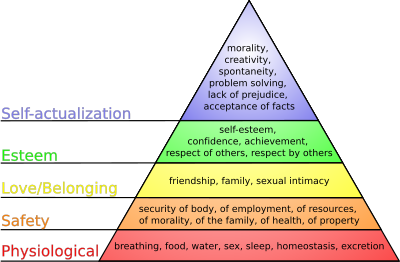
I agree with the the latter argument, because of Maslow's Heirarchy of Needs, (which I agree with), which would show that she's giving up self-actualization/esteem/love+belonging in the long run for physiological in the short run.

At any rate, what this discussion proved to me is that there is no one definition as to what is sexist and what isn't sexist, and that things that are seen as empowerment from one angle can actually be demeaning from another angle.

I discussed hard and soft racism in the last post, and you can basically substitute hard and soft sexism (or hard and soft homophobia) here. Hard sexism is an ideology that women are inferior; soft sexism is an attitude or action which demonstrates negative attitudes or associations with regard to women.

Since I covered this exhaustively in the last post, I'm just going to say something more briefly about hard/soft sexism: I believe Sarah Palin's nomination is soft sexism.

The reason is this: there are many, many qualified women in this country. Even among Republicans. Kate Fiorina, the CEO of HP. Condoleeza Rice (since apparently Bush's policy isn't discredited, as I had previously thought). Senator Olympia Snow. A controversial pick might be Democratic governor Cathleen Selebius, who I had considered a possible candidate for Obama's political ticket.

But even if Sarah Palin was the best woman that could have been chosen, she would have had to be vetted. The fact that McCain waltzed in, decided to pick a woman he'd spoken to once as his VP, and assumed that this would endear him to the women of the country is insulting. And that's what I mean by soft racism. I don't think McCain thinks women are inherently bad. But he clearly doesn't take them seriously enough.

Hard Racism vs. Soft Racism

Our language has simplified over the last generation. Simplified language often leads to simplified thought: thought is, after all, encoded in the logic of language.

So when two phenomenon share the same word, confusion may arise when multiple people misinterpret the same word to mean different things.

This applies to various "isms;" racism, sexisim, ageism, and homophobia (it doesn't end in ism but it's the same sort of sentiment). We use the term racism carefully in this country. But we also throw it around a lot. We have a lot of anxiety about what's termed "racist" and what is not termed "racist." People who use it too much devalue the word; people who use it too little let racists get away with defamation. I'm going to focus on racism right now because Barack Obama invited this nation to have a dialog about race (which has not been followed up on), but this can be applied to sexism as well--that installment is coming soon.

So let me begin by splitting the term 'racism' into two categories: "hard" racism and "soft" racism. Hard racism is a very plain sort of racism, and thus we don't hear it spoken aloud anymore. Ever since the Civil Rights Movement, our culture has decided, as a majority, that it is unacceptable to be a hard racist aloud anymore. This isn't to say that there aren't hard racists; but whenever a statement that is hard racism is heard aloud, that person is pretty much chased out of any public position they might hold.

"Hard" racism is an extreme form of racism. "Hard" racism is holding the belief that one or more races are inferior to one or more races. Adolf Hitler was a hard racist. Racial eugenicists are hard racists. Jim Crow Laws are hard racist laws. They codify the notion that one race of people is objectively (in their eyes) worse than another race of people. People who speak hard racism aloud are tagged, unequivocally, as bigots.

Today, we don't see nearly as much of that. But what we do see is a lot more of "soft" racism. "Soft" racism is hard to define. "Soft" racism is non-absolute; it does not hold that one race is absolutely worse than another. But it has a lot of negative connections with a race. One type of soft racism is ignorance. Another sort of soft racism is resentment.

Barack Obama, in his speech about race, talked about "white resentment," caused by pro-minority actions such as Affirmative Action. It is unsurprising that if one group gets preferential treatment, there will be resentment by the other. And these resentful emotions will spill over into negative attitudes. A hostility; an avoidance.

Now, these people who feel resentment toward African Americans may say that they do not think African Americans are worse, as race. Most probably genuinely believe that. But they do still feel a racial tension which cannot be dismissed as being completely non-racist. And this racial tension, or negative attitude toward African Americans may manifest itself in negative action. And that negative action will be racist, no matter how you dice it.

If both "soft" and "hard" racism are still racisms, why is it important to distinguish? Because soft racism can usually be bridged by better communication, more cooperation, and more information. For instance: affirmative action is only necessary in a community which acknowledges that all of its poor will not get opportunities to education. If a leader brings the white community and the black and latino and asian and etc. communities to work together to improve the opportunities of college education to everyone, then the resentment will decrease.

Hard racism has to be fought. I remain highly doubtful that the Jim Crow laws and segregation could have been ended simply by having Martin Luther King Jr. and Strom Thurmond sitting at a table discussion solutions. Strom Thurmond's belief that the black man was inferior was an ideology; it was entrenched in how he approached the world. And we have no need to give that any time or respect.

The reason is because "hard" racism is an ideology of racism and "soft" racism are facets or actions of racism; the latter being bad, but not as all-encompassing as the first.

Another reason "soft" racism needs to be addressed is that it often causes subconscious soft racism. People who are nervous when black men approach them in the street are exhibiting racism in a way, but it would be ridiculous to put that in the same class as joining the Klu Klux Klan. The imagery and the stereotypes and the cultures which give rise to these soft racisms need to be addressed. They cannot be ignored.

For instance, in the Amadu Dialo case, the officers involved had an ingrained soft-racism; their assumptions were that a black man of a certain age might be violent. And because of it, their reflexes (in under seven seconds; a core part of Malcolm Gladwell's book Blink) led them to shoot a man over 40 times before they could accurately and dispassionately appraise the situation. Do I think they were hard racist--that they think the black man is inferior? No, I don't believe that. But I do believe that they were soft racists; taught to expect trouble from men of a certain description. And although I have only met a few hard racists, I have barely met anyone who doesn't exhibit the occasional sign of "soft-racism" (Exhibit A: "Everyone's A Little Bit Racist" from Avenue Q).

It is important to confront these soft-racisms and make everyone aware when they are going on. Because the conscious mind can overcome subconscious soft-racism, and the conscious mind can address the causes of soft-racism. Unquestioned, they might simply fester, and lead to those cases of hard racism that we want to avoid.

And one last notice: hard racism nowadays masquerades as soft racism; sometimes it is barely detectable. This makes it hard to point to. For instance, I personally detect a hint of hard racism about the McCain campaign's allegation of Obama as "presumptuous" (David Gergen, a Southerner, called it a code-word that everyone in the South would recognize as standing in for uppity). But of course I wouldn't be able to prove it, any more than I can prove that Obama's "out of touch" ad is ageist, the way the McCain campaign alleges it is. When Trent Lott famously said that if they'd elected Strom Thurmond, we wouldn't be in "this mess," did he actually mean that we should have a segregationalist country? It seems pretty clear to me and to most people, but because of this conflation of hard and soft racism, it loses its impact.

Be on the lookout, America.

Fear of Unity: Why I'm Disheartened About The Republican Party

Before I begin: I consider myself an independent, but because of my personal beliefs and my more pragmatic approach to politics, I wind up aligned (most of the time) with the Democratic Party.

That being said, I find myself a lot more invested in the Republican party than most Democrats (or fellow-travelers). There's two reasons for this, and they are interlinked.

I am what most people would call a Democrat, but I don't fall lock-step into the party platform. And therefore, although I want there to be Democrats in Congress, I do still want there to be Republicans (or oppositional Democrats, or Independents) which represent issues on which I disagree with the Democrats. For instance: the Democrats have made a lot of issues of change part of their platform, but fiscal responsibility is still not their strongest suit (they're doing better, in my mind, than the Republican Party in general, but it's not the top of their agenda). Between the sum of two or more parties, all of my desires will be represented in the dicussions of Congress.

The second reason, which is tied into the first, is that I don't ever want one party to rule. Even if it's the party I support. Even if it was a party led by Barack Obama, taking completely his words to be law. And believe me, I'm excited about Barack Obama. But I want Obama to feel the opposing force of dedicated, intelligent conservatives. Opponents who will correct the flaws in Obama's policy, and make it better for the criticism.

Which is why right now, I'm disheartened by the Republicans. When I went into Primary Season, I hoped against hope that John McCain would win. Instead, he lost. He may be the nominee, but the ideas and platform that I remember supporting John McCain for got lost. Very early in the primary, my support for him was destroyed.

I want two parties who agree on one single principle: the truth is important. I was fiscal conservatives who agree on the hard truth that we don't have an infinite credit card; I want socialist-leaning candidates who agree on the truth that taking care of the poor is necessary. I want people who can agree that nothing is absolute, and that both sides of the issue merit examination.

I was thrilled that Obama came out on this side, because I believe he believes in the truth, in consistency, in good governance, and in dialogue.
And the old John McCain believed in that. The new John McCain hides his VP from the press, lies and lies and lies, hews to whatever opinion is popular, and in general acts with a total disregard of the truth (Harry Frankfurt's definition of Bullshit).

By the end of the primary season, I was rooting for two ponies in the Primary Season. One was Mike Huckabee. Huckabee, to a certain degree, is not my favorite man in the world: I think that his social conservatism is a holdover from an age we should leave behind. I refuse to accept anything less than equal rights for all genders and sexualities. But on the other hand, Huckabee came across as a thinking social conservative. He has always been respectful of Obama (the only one at the Republican Convention with anything nice to say) and of his Republican enemies (at a time when Mitt Romney and Rudy Giuliani were content to question patriotism and adherence to Reagan). I can imagine that if Mike Huckabee were to take the Presidency and the Democrats retain their hold on Congress, social issues might continue to be a mess but things like health-care reform and poverty issues would be able to be discussed in a bipartisan manner. I can't prove, of course, that Mike Huckabee might not get McCained, and I am extremely unhappy at the fact that he (unlike my other pony in the race) was willing to be at the Republican Convention and tout McCain at all.

But I don't believe in vilifying enemies unless they actually are villains, and certainly I think we'd have a healthier national discussion right now if Mike Huckabee was the VP candidate rather than this Sarah Palin character.

The other horse I had in the race is Dr. Ron Paul. Dr. Paul, like Mike Huckabee, attracted a significant base (in many areas, up to 15%, like Huckabee) of people who strongly agreed with him and believed in him personally. Paul, like Huckabee, is not prone to baseless character assassination. Paul, like Huckabee has a sense of humor (which you should never underrate in a politician--a lack of a sense of humor indicates a lack of a sense of perspective).

It is disgraceful of the Republican Party, by the way, that this group simply get ignored and dismissed. No representation in the Republican Convention, unless they want to be sycophantic and fall in step behind John McCain. I suppose it is his party, but what has the party done to appeal to Paul's movement? Considering all of the pandering which goes on toward the evangelicals (such as the Palin nomination).

And who is Dr. Paul's movement fueled by? Dr. Paul speaks to a group that I want more represented in politics: Libertarians. My brother is a Ron Paul libertarian, and we have discussed this at length. One of our debates centered around the Internal Revenue Service, which Dr. Paul wants to get rid of in lieu of a flat sales tax. Now, I disagree with the flat sales tax. On the other hand, Paul wants a simpler, more straightforward, less loophole-prone tax code. Even us big-government socialist Democrats can see the virtue in that, for many reasons (one of which being the fact that a complicated, time-consuming tax code winds up costing the poor and benefiting the rich). There's common ground. We can work together.

Another discussion: healthcare. Now, libertarians, in general, don't believe that everyone should be forced to have healthcare. I suppose I agree with that... if someone is determined that they don't want health insurance, that (I suppose) is their right. Now, if someone wants not to insure their child I'm more against that. One of the points my libertarian brother raised, however, is that the problem isn't that people don't have health-care, it's that healthcare is too expensive for people to have. Therefore, finding out how to lower the price of healthcare and increase its efficiency is the first step. If you lower the price of health insurance, then less people would need help paying for health insurance. And then we can discuss who the government should help in terms of health insurance.

Democrats may be too blinded by their drive for an English-style National Health Service to realize that it is just as important to lower the prices of medical care than to help pay for it. And that's something that I hadn't thought of. Libertarians had. Probably because they have a lot of economists on their side.

Now, I'm unhappy about this upcoming election because the Republican Party still seems rather lock-step behind the Neoconservative movement that I thought had proven itself bankrupt. The problem with neoconservatism isn't necessarily their platform (although certain parts of the platform are extremely unpleasant to me and to people of my political background), it's the ideology of the background. Neoconservatives are not out to govern better. They are out to pass their agenda. Compromise has not been in their history. We need compromise. We need thoughtful conservatives, not ideological conservatives.

I actually feel the same, in reverse, on a state level. My home state of California has a very bankrupt politics as well. If you don't know, a few years ago we had a Governor named Gray Davis. He promised a lot of money for a lot of things during the years when we had a huge surplus, and then the state got defrauded by the energy market he deregulated (read: Enron), the tech bubble boomed, and he rolled back parts of his platform. The state now has ballooning debt, and is governed by Governor Schwarzenegger, who replaced Davis.

The problem with California is two-fold. The major problem is the initiative system. The initiative system is a great system for passing laws, but because of a lack of distinction between laws and government programs, the voters get to directly propose and vote on government programs--in essence, the budget is decided by popular vote. And as you might expect, the California voters continue to vote to spend more money and take in less taxes.

This is a ridiculous situation. Nobody will tell the voters otherwise, because if they do, they'll lose their office immediately. But it is necessary to balance the budget. You cannot run a government with a broken fiscal system, any more than you can run it with a broken political system.

The second problem is the Democratic Party of the State of California.
When Gray Davis was being recalled, there was an strange method: on the same ballot was two separate votes:

vote 1: Recall Gray Davis?
vote 2: Who would you like to replace Gray Davis?

The latter vote being dependent on the first being passed. Now, from the perspective of the Democratic Party, they need to run a candidate in the latter. It obviously can't be Gray Davis. Now, common sense would dictate that you should support Gray Davis, and find someone else (plausibly distinct from Davis) to run for vote 2.

Instead, the Democrats ran Bustamante, the Lieutenant Governor, who ran on a platform of "I promise to continue Gray Davis' platform."

Well, that was stupid. Obviously, once the recall passed, a majority of Californians were against continuing Gray Davis' platform. And since the Democrats didn't give them any other option, they got to choose between Schwarzenegger and Ariana Huffington (Independent), or a Republican who was even more conservative than Schwarzenegger). Clearly, Schwarzenegger would win. But this gave poor Schwarzenegger the mistaken idea that he had a mandate to try and balance the budget. And ever since then, he's been at war with the bureaucracy of the state of California, and with the people who supported him.

And it has been several years since then. The only opponent who has come against Schwarzenegger was Phil Angelides (Davis' treasurer), who was just as equally unpopular. He turned out to be a crooked character too. So the question is: why can't we do better, Democrats? Schwarzenegger wants to balance the budget. This is something that needs to be done. Democrats will not win any battles by saying we should continue ridiculous debt spending. Instead, they need to confront Schwarzenegger and say, "Yeah, he wants these things, but we can deliver it. We can negotiate; Schwarzenegger can only threaten."

So until then, I support Governor Schwarzenegger's ridiculous guerilla tactics against the Teacher's Union and the state legislature. Schwarzenegger may not be the best politican we could have asked for, but he's the only one in the state taking things seriously. Where is the Democratic Party? Who else are going to tackle those problems?

We live in a two-party system in this country. That means we need both parties. And the better each party is, the better our country will be.