Showing posts with label 2008 election. Show all posts

Thursday, November 6, 2008

The Independent Voter

Megan McArdle:


Every time we have an election, the partisans confuse the fact that the independents disliked the opposition candidate, with the idea that the independents joined their party. The independents did not want to stomp the Democrats in 2004, and they do not want to stomp the Republicans now. They are not interested in advancing the electoral fortunes of the Democratic Party, any more than they were preparing to hand the Republicans a "permanent majority" in 2004. And when the various parties act as if it is so--as if the independents had actually voted to join their power-hungry two-minutes-hate, rather than voting for the guy they thought would best shelter them from the vicissitudes of fate . . . well, for the last few elections, they've had their asses handed to them on a silver platter two years later.


Yes. McArdle's original point was that partisans take such an election to be a broad mandate for the destruction of the other party. I agree with her on that point: just because Republicans have been handed electoral defeat does not mean the independent voters want their destruction, are stomping them out.

In order for independent voters to be satisfied one way or the other, one basic thing must happen: they must be satisfied that one guy is better than the other guy.

Now, if one guy sounds like the guy who's in power, and people are unhappy at the people in power, that guy will probably lose. But, the other guy has to show that he is going to be better. So: loser must be shown to be bad, and winner must be shown to be better.

I mean, that's basically the heart of the election. John McCain did not manage to distinguish himself enough with Bush, and Barack Obama managed to convince people that he (despite inexperience and, for some people, despite race) would be better.

That's what happened. And ironically enough, the catch-word in this election was change. Not just from the Republican Party (which is what I loathed about Dean's "Anyone But Bush" approach) but to something. And Change encapsulated changing the Democrats too--after all, the Democratic Congress was the one that set the record of unpopularity, beyond the Republican ones under Bush. Independent voters are very open to change. In four years from now, they may change back, if they feel like it.

What makes a party partisan is an ideology; ideology implies a long-term sense of history. Party partisans think they see into the future and see the past clearly; they think that an election is a referendum on ideology. How much of the actual debates, the actual campaign ads, etc. are actually devoted to the esoteric field of political philosophy? Not much. That is left to the politicians and the highly informed journalists; to the partisans and to the people who speak their language.

The independent voter, on the other hand, is looking at today's problems and looking at the candidate's in terms of today's solutions. That's why they're accused of having a short memory span; for instance, when John McCain made his talking points "earmarks" I think people looked at that and said, "Yeah, that's nice, but that's not today's problem." Terrorism as a concern came in at 8% because, well, only 8% of Americans are actually concerned about it at the moment. Duh. Today's problem is not terrorism: it's the economy. It's the Iraq War. It's health care.

In the year 2000, what were the problems on people's minds? I can't really point to anything specific over all. After all, we were still riding the gravy train. The result? A near 50-50 election. Why? Because it didn't really matter one way or the other. Now, if someone had sorted through the difference in Bush's ideology and Gore's ideology they would have probably come to a clear decision one way or the other. But most independent voters don't. That's what makes them independent.

Two Misconceptions

1) The "Center-left" "center-right" kerfuffle: many commentators are taking to task the assumption that the United States is a "Center-right" Country. My question: how do we judge "center right" versus "center left"?

If you go by international opinion, we are clearly far to the left fringe in terms of democracy, civil rights, and freedom; economically we're somewhat to the right but not very far. But I don't think the pundits are comparing us to countries like China, Indonesia, Iran, or Afghanistan (just to name a few).

In terms of comparing us to "The West" or the other first-world countries, I think it would be accurate to say we're "Center right." After all, Barack Obama is considering a National Health Care plan, and will meet into a lot of opposition; but even his plan does not go as far as England's, France's, or Canada's (unless I'm misunderstanding his plans and theirs, which is possible). Then again, one question that comes up is how much does this "left-right" polarization actually mean when you leave the conventional two-party system and compare different world multiparty governments?

Why the pundits are wrong: when I heard CNN consultants and other talking heads defend this claim, they said that yes, the election did lean to the left, but Barack Obama and many of the Democrats ran a fairly centrist ticket. One commentator (and her sentiments were echoed) said that the Dems couldn't win without endorsing "certain right-wing philosophies: anti-abortion, pro-gun" etc.; basically, the social conservative litmus tests. This is a bad argument, because firstly, it ignores the more important issues of economic and foreign policies in favor of the old "culture war" model (why did the Democrats and Obama win? because they abandoned the "culture war" model).

2) McCain's Campaign Is No Worse Than Any Other Republican Campaign. Perhaps. Perhaps it's true that McCain is no less or more toxic than Bush in 2000, or Reagan in 1980. That is not the point. The point is is that this time, we've decided that it's not acceptable. The point is not that McCain's campaign's race baiting and McCarthy-era rhetoric is unprecedented, or that it conforms to the previous norm. The point is that we've decided to change the norm. We just won't put up with it any more. A politician who goes down that road will be punished. If we reward the politicians who play cleaner, and knock the politicians who go on the offensive, we'll get a better class of politicians. After all, the entire meme of "Change" is precisely that the old norms no longer apply. We are not content to have our politicians match up to the politicians of 2002, or 2000. We're out to change politics.

Election Reaction. Duh.

Three days ago, the President of the United States was elected to be a black man, for the first time in history, with over 300 electoral votes and a 64% turnout, the highest since women won the vote.

I'm not going to talk about that for very long. I have a few posts in mind as reactions to various people. This first one is a reaction to this article by Will Wilkinson

The government of the state is profoundly important. And I think American voters picked a competent, decent, and sober executive officer. But this is not, headline writers, Barack Obama’s America. He is not your leader, any more than the mayor of your town is your leader. We are free people. We lead ourselves. He is set to be a high-ranking public administrator. Sure, there is romance in fame. But romance in politics is dangerous, misplaced, and beneath intelligent people. Were we more fully civilized, we would tolerate the yearnings projected on our leaders. Our tribal nature is not so easily escaped, after all. But we would try to escape it. We would discourage and condemn as irresponsible a romantic politics that tells us that if we all come together and want it hard enough, we’ll get it. We would spot the dangerous fallacy in condemning as “cynicism” all serious attempts to critically evaluate the content of political hopes.


I both agree and disagree.

Agree: You're right. We must remember we are still free people. We must allow the critical evaluation to take place; through criticizing Barack Obama, we can force him to be an even better president; to live up to his full potential. We need to balance out Obama's flaws as they emerge, we need to represent those in this country who are still strongly conservative, and we cannot let Rich Lowry's "starbursts" (I can't bring myself to link you directly to that post without the sane counterweight of Andrew Sullivan) distract us from Obama's reality.

But I want to very quickly take issue with one part of that argument, even though I have a hunch you don't actually mean it in the way I'm taking issue with it.

He is not your leader, any more than the mayor of your town is your leader. We are free people. We lead ourselves.


It is true that we lead ourselves, and are a free people. But he is our leader; we in the left movement, we who banded together, made him our leader. Now, "our" leader still has our criticism coming, and he needs to be our leader not just someone who leads us, but I want to defend the use of the possessive pronoun, and the ownership that implies.

We Obamanauts are invested in this Presidency. That means from this day forward, a duty falls to us to keep fighting, to keep engaged. Yes, we voted in record numbers. But if 2010 goes back to apathy, goes back to the old way of community disengagement... well then, everything reverses. If we think our job is done on Election Day, that now we can just sit back and snipe on the President, we can't. We own this presidency.

One of the failures of the Bush presidency, I think, is that conservatives did not own the President enough, with the exception of a few neoconservative thinkers who did. Those on the right who went into the conservative movement back during its Contract With America days... what did you do to keep the Contract alive? What did you do to keep the principles that you fought for in action? Where were you in the Primary season?

Now, the other failure of the Conservative movement is exactly what Mr. Wilkinson said; they took President Bush to be their leader, they marginalized and finally (when they latched onto Sarah Palin) closed the door on dissent. And that, too, will be coming in the near future. We shall see if Jon Stewart and Stephen Colbert can fulfill their duties the way they have until now, dispassionately. I am optimistic.

We own this presidency. We have to keep it ours--not in the sense of fighting to defeat its opponents, but in the sense of making sure it remains the presidency we fought for.

Sunday, November 2, 2008

Words I'm Sick Of

To refer back to this post of mine, I thought I'd toss together a quick list of phrases that have become meaningless, jingoistic phrases that, after November 4th, I'd like to have disappear.

1) _______ We Can Believe In.

2) Redistribution of wealth.

3) Socialism.

4) [name] the [occupation].

5) Maverick.

6) Real America.

7) Main street / wall street.

8) Ya know.


You can toss those in the bin with Mission Accomplished. I'll add to this list as more occur to me. I just... I want it to stop.

Good lord, I hope William Safire is willing to update his political dictionary.

Saturday, November 1, 2008

2008: Election

I'm going to write it down right now, just to see how my predictions stack up. You can all mock me as these predictions turn out not to be soon.

FEDERAL ELECTIONS:

Presidency: Obama
VP: Biden

Obama selects cabinet:

Secretary of Defense: Robert Gates (or Wesley Clark, but not likely)
Secretary of State: Bill Richardson (or Colin Powell, but not likely)
Secretary of Homeland Security: Richard Clarke
Secretary of the Treasury: Warren Buffet (or somebody we've never heard of)
Attorney General: Patrick Fitzgerald (or Cuomo, but not likely)

The rest of the cabinet will be nobody we've ever heard of. I don't think Hilary Clinton's going to make an appearance.

Federal Reserve Board Chairman: Dan Bernanke remains
UN Ambassador: Somebody we've never heard of, or possibly Richardson if he doesn't get State.

CONGRESSIONAL ELECTIONS:
House: Dems: 350 Seats
Senate: Dems: 55 seats (not counting Bernie Sanders or Joe Lieberman)

JUDICIARY
No appointments in the first term of Presidency.

CALIFORNIA:
PROP 8 Fails (but by a terrifyingly narrow margin)
PROP 1A [High Speed Rail] Succeeds

NEW YORK:
Federal Justice Department blocks term limit lengthening Bloomberg's term. Sucks to be him. Christine Quinn does not win the primary to run to replace him. This may just be wishfulfilment on my part.

2012: These predictions on my part are sketchier. It depends on the leadership of the Republican Party after this election. My guess is that RNCC Chair Mike Duncan is going to be forced to step down after this disastrous election. Now, the RNCC Chairmanship is selected by the Republican President, or by the association of state party chairs; depending on who winds up selecting the new RNCC Chairmanship, it might have different results.

My hunch: Sarah Palin emerges as party chair of a party that's tacking even further to the right, but in 2012 Mike Huckabee wins over the nomination by appealing to the same right-wing values that Palin has tapped into in a manner not seen to be as self-destructive.


(UPDATE: I originally posted this on my Facebook, and decided to put it over here. In the meantime between my posting that there and posting it here, I suddenly realized that I had forgotten an important name in my considerations of Obama's cabinet--Holbrooke! I'm not going to change the prediction, but I really should have remembered that Holbrooke is almost certainly going to feature in the foreign policy. Also, while I'm at it, I should point out that while I didn't mention this before, I think that John McCain will not stand for re-election in 2010. In the off-chance that he is bloody-minded enough to run, I don't think he'll make it. Right now, he's on the verge of losing the Presidential election in his own home state.)

Friday, October 31, 2008

Comment I Posted To Matthew Yglesias

Matthew Yglesias on the changing attitude toward "redistribution of wealth."

A theory about the shift in attitudes toward “redistribution of wealth.”

Mikhail Bakhtin, in his book “Rabelais and his World” referred to obscenity’s role in everyday discussion by saying that the pejoratives became dissociated from their actual meaning, and became a whole phrase on its own; basically, it became an expression rather than an actual phrase, rooted in the meanings of the word.

I think that’s what happens to talking points: a phrase in the language becomes something ideological, and therefore the words get uprooted from their meaning. Between April and October, McCain has taken the phrase “redistributing the wealth” and turned it into a euphemism for socialism–itself, in the US, a euphemism for dictatorial oppression and big government. So the question is heard by the listener, and it means something completely different now than it did five months ago, if you subscribe to McCain’s euphemism.

I don’t think attitudes have changed. I think McCain has shifted how we use language.

(Another example of this: McCain is firmly against the ideologically charged “regulation” but in favor of the ideologically neutral “oversight.”)

Monday, October 20, 2008

Open Letter To The Conservative Minds

Hello to the Conservative Minds of America;

Hello to Christopher Buckley--(loved Thank You for Smoking!), hello to Kathleen Parker, hello to Andrew Sullivan, hello to David Frum and David Brooks. I'm addressing this to you because in recent weeks, a divide has come between you and the Republican Party. The real source of this break is Sarah Palin, and some of you have observed that the Republican Party has left you, rather than you having left it.

The news this week, written in the Times and in your blogs and all over the media-sphere, is that you all have broken with McCain-Palin '08, and for that you are the target of your party's vitriol and attack. Conservative minded papers are breaking with McCain-Palin 08, turning Democrat for the first time since 1964. So the question remains: where now for you all?

Many triumphant liberals have taken it that you have endorsed Obama-Biden. Some of you have. Some of you have said that you're not going to vote. I certainly haven't heard anyone endorsing Bob Barr, but that's not surprising--after all, you're smart conservatives and a "Libertarian" who voted for the PATRIOT Act is no more appealing to you than the current McCain Palin ticket. But the question remains: where now for you all?

It's interesting that the date 1964 is the last time the Republican Party has been torn apart like this. Admittedly, I wasn't alive them, but from my reading of history, it appears that that was the date that "conservative" Republicans seemed to take the ball from "moderate" Republicans, as they were labelled in those days. That was when Barry Goldwater took the nomination, over Governor Rockefeller's brigades (note that there was a Romney in that primary too, as pointless as that trivium is). When Reagan won in 1980, George Will wrote:

It took 16 years to count the votes [of the 1964 election], and Goldwater won.


But Barry Goldwater was a libertarian on social issues, after all, he said:

When you say "radical right" today, I think of these moneymaking ventures by fellows like Pat Robertson and others who are trying to take the Republican party and make a religious organization out of it. If that ever happens, kiss politics goodbye.


We've got a party that, on certain issues, falls to the right of Barry Goldwater. We've got a problem, and you all know that. The step to the right that Barry Goldwater started, and the step to the right again that Ronald Reagan took, is becoming a step too far. But you all know that, that's why I'm writing you this email.

I'm just begging one thing of you: don't let the Party leave you.

You all are the brightest of the Conservative movement, the ones who give it brains and sophistication. A party which hates the elite is deliberately dumbing itself down as fast as it can, so that it can't provide any meaningful solutions, or counterbalance to the Democrats. That's why they need you, even if they don't know it yet.

You can't give up. The fate of the country needs you.

The Democratic Party needs you, just as much as the Republican Party needs you, and almost as much as the American Public needs you (as much as they'll scream that they don't). You see, intellectual rigor improves everybody. When Democrats are right, they'll be able to prove it in a field of difficult discussion. When they are wrong, they won't be able to get by while being wrong. And the same should work vice versa. Constructive criticism is the most important social function that we can exercise as citizens. I have full faith that you won't stop. But right now, just criticism isn't enough.

Bill Kristol created this Sarah Palin monster. The fringe of the Republican Party is very good at getting attention; for their allies, they appeal to the base instincts of fear and greed and get them excited. For their enemies, they also appear to fear: fear of what their opponents could become in power. Sarah Palin gets a large share of attention because her insane, nativist rants against the "other" are far more 'interesting' than intelligent discussion on the merits and drawbacks of nationalizing the banking system. Not just to the huddled masses who she's playing to, but even to us intelligent people: we may agree or disagree with various policies, but Palin hits us right where we hurt: a vision of what politics could be if we don't fight this right now.

So what are you going to do, Conservative Minds? Might I make a suggestion? Find the anti-Palin. Go out there, look at Conservatives. Find someone you respect. And put them forward. We've noticed Barack Obama's quiet and calm demeanor. He launched himself into the public eye in the Primary by being loud and eloquent. But some Republicans out there might be quiet and calm all the time. They're not going to get much face time. Start making their names known.

Who do you look up to in the Republican Party? Do you see any rising stars? I've heard a few names thrown around; Governor Bobby Jindal of Louisiana, for instance; or older figures like Senator Olympia Snowe. Get them involved. Contact them for statements. Light a fire under their ass, and make them take back the party.

The Republican Party can't keep moving right forever. If they lose more and more people, there won't be a Republican Party. The next time the Republican Party has a Presidential Primary, they're going to need someone to do what Barack Obama did for us in the Democratic Party: to show us a respectable future, a future that we as party members can be proud of.

And Barack Obama's creation as a figure on the national stage is not an accident. Somebody noticed him, among all the other freshmen senators, and decided to make him keynote the 2004 Democratic Convention. That's when I first heard him. And when he said that night that there aren't Red States and Blue States, but rather these United States, I knew that I had a future in the Democratic Party that wasn't Nancy Pelosi or Harry Reid, both of whom I dislike and would prefer not to be represented by. In fact, I didn't self-identify as Democrat until Barack Obama had won the primary. It might be hard for you all to call yourselves Republican until you have another Ronald Reagan to make you proud to be Republicans (or for Mr. Sullivan, another Margaret Thatcher).

It's going to be difficult. Many people are going to want to style themselves as the second-coming. If McCain-Palin loses, Palin's career will most likely be over; it's rare for a defeated VP candidate to make a convincing Presidential candidate later on, especially since if this election plays out the way it looks like it's going now, she's going to wind up shouldering the blame. Every Conservative who has turned against McCain Palin has been vocal about citing her selection as a turning point in their lack of support, and if part of the core of conservatism blames her, it'll be easy to see her negative effect on the election. So she'll be out.

Who's going to represent you in 2012?

What are you going to do about 2010? Where are the Congressmen to send back to Congress? Every few weeks we hear about abuse of power and sexual misconduct from Congressmen. They continue to cater to President Bush's agenda. They don't represent the future of the Republican Party. Who will?

That's your challenge for the next several years. These issues are too important for you all to withdraw, to say that the Republican Party has left you behind, and to just sit back and wait until someone does come along. It's up to you to construct the party of the Big Tent once more.

Yours,

Guy Yedwab

P.S. Just don't remake your party too well. I still want liberals to run the country!

Saturday, October 18, 2008

Conversationalism + 2008: Humor: Response to Andrew Sullivan

(You can read the post I was responding to here)

As one of these newly emerging youth voters, and also am a huge fan of shows like The Daily Show and The Colbert Report, I'd like to expand a little about what you said when you said "The next generation is deadly serious about this country but they also manage to have fun with it. That's the Millennials' real message, it seems to me." It's something a little more serious than fun: it's humor. See, one of the cores of humor is perspective: in order for things like irony or sarcasm to work, the joke implicitly creates perspective towards the truth. If you can remember the terrible rip-snorting fun that was the 2006 Press Correspondent's Dinner with Stephen Colbert, you'll know that it was funny (or really not funny, depending on your perspective) precisely because of the truth that was imbedded in every joke.

I'd like to point out that both Barack Obama and John McCain were frequent guests on the Daily Show (McCain was at one point--and may still be--the most frequent guest of the Daily Show). They both share an ability to laugh at themselves, to poke fun, to show a little bit of perspective. As the campaign marched forward, I was afraid John McCain had lost it completely, but at that dinner recently he showed himself able to. And how did he appear at that dinner? A lot more in touch with the truth than he has been lately. Comedy requires that self-awareness that you and I both look for in a candidate, and it also means a candidate has to give up their self-importance a little in order to make a self-effacing joke. After all, Stephen Colbert's Press Correspondent's dinner was far more effective than if Jon Stewart had done it because Colbert made himself an image of mockery, and then included Bush and others into that mockery. Note that Nancy Pelosi has, on a couple occasions, warned Congressmen not to appear on the Colbert Report lest they get a mocking that they can't recover from.

I want a candidate who'll have a sense of humor. I mean, I wouldn't choose humor over healthcare, but at the same time, the ability to laugh and joke and break the ice, to see oneself clearly and have perspective on the world around us, to be able to burst self-importance and relax the walls a bit--that ability gives me a lot of faith in their ability to pass healthcare. And in this pompous age of ideology, vitriol, and hatred from both parties toward each other, maybe the future of both parties needs to have a lot more humor. Like Reagan deftly joking about his age, Bill Clinton's ability to connect with people (he hasn't seemed very funny lately, though). Even Nixon's memorable "Checkers" joke separated him from a pact of less worthy candidates. I'm not saying Nixon was a great candidate, but if you look at the way that Nixon and Mao were joking around together, you'll see why it was that it took Nixon to go to China.

Of course, in 2008, there is a limit to the sense of humor I'll take. As someone who wanted McCain to be a different candidate than he turned out to be, I feel pretty "punk'd."

Tuesday, October 7, 2008

Conversationalism + 2008: Libertarianism + Socialism

My brother, being a dedicated Libertarian, turned me on to the economic principles and political philosophy of libertarianism. Other guides for me steered me towards socialism, and its wellsprings in the economic hardships of Europe during the Industrial Revolution. Recently, I have been thinking about the two of them, and about my upcoming ambition to enter the realm of politics and start putting my money where my mouth is. Which philosophy should I use to guide me?

Well, of course, that's silly. What libertarianism has taught me, if I had to put it into one sentence, is that too much government can do terrible ills to society. And what socialism has taught me, in one sentence, is that too little government can do terrible ills to society. Libertarians, for instance, tend to focus on how much government the money spends, and on our debt. Socialists focus on the economic hardships of the poor. But let's put those two major doubts together: why is one of the most expensive governments of the last few decades completely failing to address the economic hardships of the people? We have one of the largest governments, and one of the most unresponsive we've ever had.

A libertarian is angry right now because we're wasting tax dollars that could be better spent. Socialists are angry because the people who need our tax dollars aren't getting them. A libertarian hates oil subsidies because it's unnecessary interference in the market; socialists hate it because it makes the rich richer with money taken from the poor and the middle class. A libertarian opposes the War in Iraq because of the budgetary toll, and because of the interventionist role it gives America. A socialist opposes the war because it hurts the people at the bottom while enriching businesses.

If libertarians want a smaller government, and socialists want a more effective government, they both should have aim in 2008: tackling corruption and out-of-control abuses of power in Congress and the White House. The same aim. They should be united, because both of their ideals are being compromised.

The government can be shrunk while still increasing the benefits to the people who need them the most. For instance, the ridiculous incentives for ethanol fuel that sparked food riots all over the world are a waste of our taxpayer money, and only drive up the price of fuel. Another way that libertarians and socialists can unite to achieve both their aims.

Will they disagree on certain issues? Perhaps. Libertarians appear to be against health plans in general, whereas it is one of the issues at the core of the socialist movement. But if a productive conversation is to be made, people of both philosophies should stop seeing themselves as mortal enemies and seeing where they are united.

I feel myself in both camps. I want the government to reach out and make education better, but I don't think we need do be hugely in debt to do it. The real issue is not how much we spend on education, but rather how much each dollar is buying.

What if the President put together a team to assess the buying power of each US Governmental dollar? What if Department of Education aid was compared with, for instance, DonorsChoose? The DonorsChoose website allows the private sphere to see what they're buying, to assess what they think are necessary expenditures. Increased spending should mean a system of evaluating the impact of that dollar.

When Libertarians want to cut funding to ineffective programs, Socialists shouldn't oppose them; they should save their battles for the parts of this government that are actually doing good. And if Libertarians have a better way to tackle the problems Socialists want to tackle, let them hear it. If you have a health care plan that will get many more Americans insured without a large governmental involvement, put it on the table.

On many charts and graphs of political sentiment, "Libertarian" and "Socialist" are considered to be 'polar opposites,' from the inane simplification that the goal of Socialists is to create a large government. Socialists are not totalitarians; true, larger governments tend to be the byproduct of a socialist-leaning government. But then again, larger governments also tend to be the byproduct of many libertarian governments.

Take a prime example: President Bill Clinton. Under his administration, we started paying off the National Debt, we made the welfare system more efficient. But he also proposed a health care plan for America. Budgetary concerns and social concerns were equally on his mind, as they should be on the mind of any president. Was he helped by the tech boom? Perhaps. But I would like to contrast his presidency with that of Governor Grey Davis of California, whose state unarguably reaped the windfall of the Silicon Valley boom. But what did he do with that windfall? He felt compelled to spend it, on measures (good as they may have sounded) that were later rolled back when the boom came back. Ever since then, the deficit has been growing in California, culminating in California's emergency request to Treasurer Henry Paulsen for $4 Billion. Why? Because he never considered the fiscal impact of his plans; he never attempted to make sure that he was spending within his means. Libertarians clearly were not on his mind, and socialism suffered.

That's what I have to say. I have libertarian instincts within me, and socialist instincts. Were I to be in some sort of elected office (as I hope one day to be), I would have to listen to both sets of instincts. "Deregulation" as an overarching philosophy is misguided, but so is irrational regulation--No Child Left Behind showed what irrational regulation can do to a system, whereas the current financial crisis shows what irrational deregulation can do to a system. The point is to have both tools in the pocket, and understand how they operate.

Sunday, October 5, 2008

Conversationalism + 2008: Palin And The End of the Line

I take the injunction of the AFL-CIO secretary-treasurer and it must be. I have to say it.

Required reading for the post.


Sarah Palin and John McCain have officially embarked on a campaign of discrimination.

Now, I'm not saying it's necessarily a racist campaign; Sarah Palin's remark that Obama "doesn't see America the way we do" could be equally anti-Democrat, anti-Elitist, anti-black, anti-Liberal, etc. The point, however, is that Sarah Palin is claiming to have a monopoly on America.

I want to talk about one of the most crucial point of the Vice Presidential Debate for me. In terms of our culture, and our cultural dialogue, there was a clear choice that was presented at one point. Ifill asked the two about how to turn around the partisanship in Washington.

Here's Joe Biden:

Mike Mansfield, a former leader of the Senate, said to me one day -- he -- I made a criticism of Jesse Helms. He said, "What would you do if I told you Jesse Helms and Dot Helms had adopted a child who had braces and was in real need?" I said, "I'd feel like a jerk."

He said, "Joe, understand one thing. Everyone's sent here for a reason, because there's something in them that their folks like. Don't question their motive."


Here's Sarah Palin:

But the policies and the proposals have got to speak for themselves, also. And, again, voters on November 4th are going to have that choice to either support a ticket that supports policies that create jobs.

You do that by lowering taxes on American workers and on our businesses. And you build up infrastructure, and you rein in government spending, and you make our -- our nation energy independent.

Or you support a ticket that supports policies that will kill jobs by increasing taxes. And that's what the track record shows, is a desire to increase taxes, increase spending, a trillion-dollar spending proposal that's on the table. That's going to hurt our country, and saying no to energy independence. Clear choices on November 4th.


In other words, in terms of bipartisanship, Biden says we shouldn't slander each other's motives, and Sarah Palin says you should pick the party that isn't out to "kill jobs," "hurt the country," and "say no to energy independence."


This is ludicrous.

So, a few days later, seeing that the polls still aren't backing her ridiculous brand of folksy anti-elitism, she has decided to kick it into gear, and make the heart of their campaign an attempt to question Barack Obama's motives. Because yes, clearly, a Hawaiian born Christian who was a civil rights lawyer, a professor, and has been two years in the Senate, doesn't see America the way 'the rest of us' do. He sees it the way terrorists do. Oh, and by the way: nobody has spoken as much about the exceptionalism of America as Barack Obama--it's the heart of his Yes We Can campaign. I wish he'd truck that out.

But this is unacceptable. Whatever McCain or Palin are trying to do, this is an unacceptable move in the campaign. I cannot repeat this enough. This is unacceptable.


I wanted McCain to be the end of the Republican Party as partisan hackery. I wanted him to show that two parties could both decide to stand a little taller and live up to America a little better. Where has McCain gone?


This is unacceptable.

Wednesday, October 1, 2008

2008 + Government Reform: Justice

It is clear that in the last eight years, our country has gone on the wrong track. One of the ways in which it has worst offended is in our system of Justice. After all, Justice is one of the things we hold dearest to our hearts: The Statue of Liberty, the Constitution, the Declaration of Independence; if you can tie all of these (and other) American governmental bedrocks together, it's under the banner of justice.

War crimes have happened. A close examination of the facts leading up to the Abu Ghirab scandal, the extraordinary rendition scandal, the CIA "black sites" scandal, and other scandals besides--as well as the official line (now abandoned) within the White House that we operate outside of the Geneva Conventions all culminate to make that point.

How do we address justice? That debate is raging right now.

Andrew Sullivan is correct when he says that any attempt to prosecute former members of the Bush Administration will have severe blowback. It's as though Newt Gingrich, by pressing for impeachment of Clinton, bought President Bush all the amnesty he needs. Almost every single member of the Bush Administration has been liked to one crime or another, and as President Bush likes to say: the members of his Administration are ultimately his responsibility. They serve at the pleasure of the President. So why the blank check?

The answer is that our own political system is too tied up in itself to effectively prosecute itself. If Barack Obama sets up a satisfactory Special Prosecutor, like Prosecuter Fitzgerald who handled the Scooter Libby trial, then perhaps some sort of justice can be approximated. But it is highly unlikely that this will really get to the roots of the problem: as in the Scooter Libby trial, the ax-men may get caught, but the people who enabled them will go scot free.

But it cannot be acceptible that the people who authorized torture are allowed to go free. It cannot be acceptible that the callous dismissal of human lives be allowed to go unpunished. It cannot be acceptible that the trammeling over the US Constitution be ignored. Because if we don't address these ills, it will be worse than a lost opportunity of justice: we will forever communicate that these things are acceptible. Suppose the next President authorizes torture for foreign civillians on our custody, or secretly sets up renditions within the United States. Will they be able to argue that they are merely following a precedent set by President George W. Bush? One of the arguments I have heard in Bush's defense is to cite the losses of civil liberties in previous administrations--as though whatever we have done now pales in comparison to those heady days. But it does not.

The challenge for the incoming president will be to restore the image of Justice in the United States, and in the world.

2008: Sarah Palin

Just a brief post here. I thought I'd play a little game. Sarah Palin is a vice presidential candidate, and, well, I've kind of harbored a little bit of a desire to run for office later in my life. But I'm worried. Would I be qualified? Would I be the sort of person that John McCain could turn to for advice?

I have no experience in public office. I am still studying for an undergraduate degree in college (studying Drama and Theater Production). My best executive experience was directing a play last year (on a budget of $300, and with a cast of 7 and a crew of 6). So, clearly, my credentials are not quite as good as Sarah Palin's.

But then I thought further. And I realized that I am more qualified than Sarah Palin in several fields.

  • Foreign Policy Experience: I was born as a passport holder. I travelled to Israel every year--and stopped in plenty of European countries every year! That means my family lives in Israel--and they're neighbors with Syria and Lebanon. So I keep an eye on Syria and Lebanon, which means that I guess I'm pretty qualified in their affairs.
  • Knowledge of Law: Sarah Palin could name one Supreme Court Case: Roe v. Wade. I can name Roe v. Wade, but I can also name the more accurately applicable Supreme Court Case (Casey v. Planned Parenthood) which changed Roe v. Wade's absolute protection of abortion into a more qualified one. How about the Dredd Scott case, which ruled that African-Americans were not human beings under the law, and couldn't sue--and that property transported over state lines remains the property of the owner, regardless of law? Or how about Plessy v. Fergussen, which ruled that "separate but equal" was the prevailing standard, and Brown v. Board of Education, which overturned it? What about Marbury v. Madison, which established Judicial Review? Cherokee Nation v. Georgia, which ruled that the Cherokee Nation had the rights to their land--but was overturned informally by Andrew Jackson's "You've made your decision, now let you enforce it?" Maybe I'm barking up the wrong tree. I'm clearly qualified to be a Supreme Court Justice, at this rate. John McCain: make me your Harriet Myers.
  • Following of the News: Sarah Palin was unable to name any newspapers or magazines she follows current events in. Here's mine:
    --Andrew Sullivan's Daily Dish
    --
    Michael J Totten's blog
    --Google News' roundup (which includes the major newspapers, AP, Reuters, the major networks, etc.)
    --The Daily Show, The Colbert Report, The Bugle (three major satirical news programs; the latter from overseas)
    --BoingBoing (a technology / libertarian blog)
    --Slashdot (news for geeks)
    --15 or so Art Blogs
    --Prague Post/Prague Daily Monitor (I'm in Prague right now)
    --The official updates of Representatives Carolyn Maloney and John Campbell (my two representatives)
    --Lawrence Lessig's blog
    --Creative Commons' blog
    --SCOTUS Blog (updates on the Supreme Court)
That's about it. Clearly, from my resume, you can see that I'm as qualified to be the Vice Presidential candidate. Also, I can bring in the Jewish vote, the young vote, and the purely hypothetical vote, because I'd never accept a position as your running mate.

Tuesday, September 30, 2008

Conversationalism + 2008: On The Street Where You Live

Yet even as we speak, there are those who are preparing to divide us, the spin masters and negative ad peddlers who embrace the politics of anything goes. Well, I say to them tonight, there's not a liberal America and a conservative America - there's the United States of America. There's not a black America and white America and Latino America and Asian America; there's the United States of America. The pundits like to slice-and-dice our country into Red States and Blue States; Red States for Republicans, Blue States for Democrats. But I've got news for them, too. We worship an awesome God in the Blue States, and we don't like federal agents poking around our libraries in the Red States. We coach Little League in the Blue States and have gay friends in the Red States. There are patriots who opposed the war in Iraq and patriots who supported it. We are one people, all of us pledging allegiance to the stars and stripes, all of us defending the United States of America.


This is the paragraph, in 2004, that turned me into an ardent Barack Obama supporter. It was a promise that there was an idea of America separate from party politics. And a rejection of the cutting and dicing of America. It contrasted sharply with another political candidate of the time:

Today, under George W. Bush, there are two Americas, not one: One America that does the work, another that reaps the reward. One America that pays the taxes, another America that gets the tax breaks. One America - middle-class America - whose needs Washington has long forgotten, another America - narrow-interest America - whose every wish is Washington's command. One America that is struggling to get by, another America that can buy anything it wants, even a Congress and a president.


This is an older meme, but it gained equal traction when John Edwards deployed in 2004. Like the Obama view of America, it unites people regardless of ideology--but unlike Obama, it still creates a huge division in America. The "narrow-interest" America versus the "middle-class" America. It harkens back to How The Other Half Lives. But it's still a politics of division. A politics of the enemy. The rich, entitled (bourgeois?) versus the everyday, ethical man.

In 2008, it reared its head again not just in the visage of John Edwards (still under the Two Americas name), but under Mike Huckabee:

I'm not a Wall Street Republican, I'm a Main Street Republican.


Perhaps a testament to the lasting influence of Huckabee is that now, during this economic crisis, you literally cannot open your mouth to talk about the bailout plan without saying the phrase "It has to work for Main Street, not just for Wall Street."

Even Barack Obama has been using this phrase, which makes me sad. What happened to "These United States of America?" Certainly, it hasn't been visible in Nancy Pelosi's "leadership," which most recently consisted of blaming House Republicans for this mess. That doesn't mean that House Republicans don't share the blame--the point is that we're not even talking about the issues, the solutions, or reality.

Instead, we're trumping up this economic division. Is everyone in the financial industry evil? Maybe the CEOs and the Investment Branches. But I have several close friends who work as bank tellers. You know who suffers if Washington Mutual or Wachovia branches close? They do. I agree that there have to be strings attached, etc. etc., but if we start employing the language of a culture war, we start setting our priorities incorrectly: our priority is not to punish the financial industry, or to find blame. Our priority is to straighten out the markets.

We can start creating accountability, rewriting the legislations, straightening things out after we've guaranteed that our inaction hasn't caused a 700 point in the DOW Jones. Just to reiterate: the stock market is not just for rich speculators: people have their savings there. Banks are not just for rich speculators: people have their savings in there.

Notice: when Americans are asked how they feel about the bailout, they react strongly against it. When they are asked how they feel about a rescue package that has exactly the same terms as the bailout but isn't called a bailout, they react strongly in favor.

And what this really boils down to is: why are we using any of the language of politics right now? Why are we debating "Wall Street" and "Main Street"? In fact, why are our Congresspeople publicly debating the Bailout package? They should be in meetings, privately debating the bailout package. This is the moment for Congress to quickly and quietly get to its work.

I don't mean that it should be secret--Congresspeople should keep the American public informed as to how the package is going, and once an agreement has been reached, it should be presented to the public. All I'm saying is that trying to play the political game at the same time as the statesman game is going to hold us back.

All I can do is remind you: we have no red states, or blue states: only these United States. There isn't a Rich Person's Economy and a Poor Person's Economy: there's the World Economy. When you find it more important to debate whether the free market solves everything, or to vilify the very House Republicans whose support you need to pass this bill, not only are you watching the US market decline, but the Eastern market, the European markets. Everyone hurts.

Monday, September 29, 2008

Conversationlism + Pragmatic Theater + 2008: Sarah Palin And Tina Fey

I don't think I have to make a very long post here. Tina Fey's satire of Sarah Palin is a revitalizing moment for Saturday Night Live. I hope they can keep the satire up this sharp and fresh. It might strike you that Tina Fey's satire of Sarah Palin is fairly straightforward and basic. I just want to highlight the reason it's working so well.

Required Viewing

What can you notice about this side-by-side comparison? Tina Fey has discovered something about satire. Sometimes, all you have to do is present the truth in a frame of satire, and the laughs will come in themselves. It takes me back to an old South Park episode which mocked Scientology. All they had to do was tell the tale at the basis of Scientology, with a disclaimer at the bottom: This is what scientologists actually believe.

I sometimes see or hear the same thing out of Jon Stewart: "I'm not making this up!" All the satirist has to do sometimes is present the absurdity of the moment, shrug, and say, "That's reality."

To see members of the press--serious members of the press--still arguing on behalf of Sarah Palin as a serious candidate is ludicrous. And all you have to do is introduce perspective. Sometimes that's all that comedy has to be: perspective.

One Example 1

Example 2

Those two examples, I think, exemplify Jon Stewart's role as the satirist providing perspective.

Conversationalism + Identity + 2008: Sarah Palin + Katie Couric

Required Viewing

I felt a deep pathos for Sarah Palin during that interview. Many of her positions are abhorrent to me, and I am shocked that anyone would have believed that she would be good on the ticket. But she struck an emotional chord within me, a chord of fear, while watching specifically these sorts of moments in her interview, and having thought about it, I'm starting to realize what it is.

Sarah Palin is trying to learn a foreign language.

When I was growing up, I was taught Hebrew, because I was Israeli-born and American raised. My family all spoke Hebrew, and indeed from my parents' generation upward Hebrew was the dominant (if not the only) mode of communication there was. When I was young, the frustration of learning a language drove me wild--I hated it, and I consequently dropped Hebrew lessons.

Part of me regrets that to this day, but my abortive attempts to learn language since then have made me feel that I was correct in my choice. A year of Spanish I in middle school, four years of French in High School (culminating in a 2 on the AP French exam), and, just this year, studying introductory Czech--and each time, I have not done well.

But there is something more fundamentally frustrating or disturbing than not doing well in language classes, which I only realized today. It's a frustration I feel when I try to speak to a Czech person in Czech, and they respond in English (recognizing instantly my inability to communicate). It's equally the frustration I feel when I have to dumb down my language to get across to someone who thinks they know English, but don't.

Before action, comes the word, and part of my self-awareness is my self-awareness about how I communicate. Part of the urge that creates a writer, after all, is the love of words--and furthermore, an identification with words and communication. Before I am anything else, I am a creator--and the first step in the act of creation is writing and planning; placing ideas in definite grammatical structures. George Carlin talks about how you start with an airy, indefinite thought, and then you attach a word to it, and BAM-- you're stuck with that word for that thought.

But what happens when it becomes impossible to communicate? I can imagine myself happier unable to walk than unable to speak. I have a definite fear of loss of speech, which is in fact tied into my fear of death. I identify myself with my thoughts, my ideas, and my opinions; death extinguishes them. So the solution to death is to spread my thoughts, my ideas, my opinions. Shakespeare's body may have died, but his thoughts/ideas/opinions live on because they have gained traction. I not only fear dying, but I fear dying and taking everything I think and feel with me.

That's why I write: if no one will listen to my ideas and thoughts and opinions, I must write them down, so that if the time comes that someone is interested in them, they will be waiting for them. I have a fantasy in my head that, after I die, people will come through my computer, looking for my ideas and thoughts and opinions. And they'll discover that I laid it all out--my computer is laid out with a highly organized filing system, so that people will know what I thought, what I was here for.

Imagine if I lost all of that. Imagine if I lost the opportunity to make myself known. Imagine if I dealt with someone who is trapped in seeing me as "The Other" because I cannot make myself clear to them. Imagine that. It is the same tragedy as a paralyzed athlete: he who identifies himself with physical action will mourn the loss of that action, and he who identifies himself with communication (not just thought; communication) will mourn that in a deep way.

I have trouble watching Sarah Palin in these interviews. It was alright for me when she was just speaking, saying foolish things like "Thanks but no thanks" or "The difference between a hockey mom and a pit bull...". She knows how to speak like a politician. But watching her try to speak like a statesman, is like watching my comrades in Czech 1 trying to form a sentence about their family when they've forgotten all the vocabulary involved.

You can see her clutch to phrases she knows. Take, for instance:

"So health care reform and reducing taxes and reining in spending has got to accompany tax reductions and tax relief for Americas."

Let me diagram this sentence for you:

[Positive initiative 1] + [positive initiative 2] + [positive initiative 3] + [positive initiative 4] + [positive initiative 5]

Furthermore, if you notice, Positive Initiative 2, 4, and 5 are all the same initiative: raising taxes. They're just different phrases for the same thing.

She memorized the vocab, and she's struggling to deploy it. It deeply unsettles me, emotionally, because I can't imagine the horror of being tested on language I don't know. The inability to communicate, in its sharpest form.

If Sarah Palin's nomination only accomplishes one thing, let it be that it gave me a little more insight into the darker side of myself.

Sunday, September 28, 2008

Conversationalism + 2008: How Bin Laden Will Lose The 2008 Election

I was once reading a text that was trying, through belabored logic, to prove that September 11th was a Performance Art piece. Of course, it all depends on what you consider "art" to be. It's hard to define September 11th in a way that is separate from art, but it strains the term "art" to the point of being almost meaningless.

Such an argument belies the dual role of terrorism. From one aspect, the act of terror is artistic (not in the positive sense) in many ways: it is carefully planned, it is loaded with intentional symbolism, and is created more for the benefit of its audience than its actual tactical value. Bin Laden attacked the World Trade Center because it was a symbol that he wanted to attack. Part of the goal (part) was the pain, fear, and sorrow he instilled in every American, which he thought would come closer to achieving his aims. In a way, terrorism is actually closer to propaganda than art (try finding that line).

But there is, of course, a second role of terrorism which is not in any way attached to art: it is an act of destruction. This is actually important for me in distinguishing art from terrorism: art is, on the whole, an act of creation.

I'm saying all this as a way of looking at terrorism as a very flawed mode of communication. It's rather like the point in an argument when the words fall away and someone decides to throw a punch. But in terms of the overall world culture, the point of terrorism is to influence the culture.

How might Bin Laden want to influence our culture? He has many achievable, specific goals as part of his campaign, and between his tapes and his actions he wants them put on the table. But the fundamental success of 9/11 is the key to his first and foremost objective: he wants to be a part of our national dialogue.

If Bin Laden saw his role today in our culture as the be-all and end-all of evil (the way Adolf Hitler was and is), I think he would be happy. We have elevated him to a position wherein his concerns are of concern to us all.

Last weekend, al Qaeda allegedly got back in the game, in terms of bombings. And their allies, the Taliban, are slowly mounting the war in Afghanistan, and gaining ground. The former is terrorism; the latter is guerilla warfare.

What are we talking about this week? Well, the first debate spent a lengthy amount of time talking about Afghanistan and Pakistani sovereignty, but the name "bin Laden" and "al Qaeda" was not a centerpoint of the debate. We were talking tactically; we were not speaking out of fear. And still, the number one issue on America's mind is the economy. Bin Laden is not the biggest threat to Americans: foreclosure is. Bankruptcy is.

What does this mean for Bin Laden? It means that his group returns to being marginalized on the world stage. It means that the United States is free to take action without hushed talk about "emboldening the enemy." It means that our public discourse will be free of the misleading connections of every evil in the world to one super enemy.

This, of course, is why I was horrified the other night when I heard Tony Blair, on The Daily Show, say that all of the terrorists of the world were basically the same forces. More specifically, he said that Hezbollah, Hamas, the Sunni Militias, and the Taliban were all part of the same "forces" at work. To the degree that each of these are Islamic fundamentalist groups, perhaps. But that is where the similarity ends. As Jon Stewart rightly pointed out, each of these groups has predominantly nationalistic goals.

Contrast Hezbollah, for instance, with Al Qaeda in Iraq, or Al Qaeda in Europe. Both of those franchises were started by Islamic fundamentalists who looked to Bin Laden for leadership, and pledged their small fragment of Islamic fundamentalism to Bin Laden's aid. These groups are not growing outside of Afghanistan. Although Islamic Fundamentalism, as an ideology, continues to gain traction, they are not all linked and directed by Bin Laden, as Bin Laden might have dreamed.

There are more empirical links, in terms of weapons and funding. And those include Iran and Syria prominently. But those links also include China and Russia--not for ideological reasons, but for tactical reasons. After all, China may be supporting terrorism abroad, but is against the Islamic guerillas among the Uighurs, they are far less supportive.

Bin Laden will lose this election if he fails to turn the world conversation toward himself. And I have every faith that he will lose this election. I was worried, in the wake of the bombings, that he would come to dominate our national dialogue again, and ruin the chances of addressing the real problems we need to address in this nation. Thankfully, he may have taken lives and destroyed property, but he is losing the war.

Saturday, September 27, 2008

Conversationalism + 2008: How Our Conversation's Going

Culture is a conversation, and in a democracy, one of the most important culture-defining conversations is an election. Overall culture is often given many defining characteristics by its leaders: often, much of the culture defines itself in response to that. In a democracy, the choice of leaders is, in effect, a choice of cultural values and guiding philosophies to engrain in our culture. As our candidates compete, not only are we voting for policies, we are voting for the philosophies which underly policies. Hence, in previous elections, you get candidates winning on platforms built on the Bible or Reaganomics, even they don't necessarily apply in the situations they're being applied to. Why? Because the voters are responding to principles they agree with, regardless of the actual issues.

So, how is our conversation going in this election cycle?

I think it's going really well. It's still having some problems, but it's alive. Two points:

  • The Debate: This nearly was a debacle. If McCain had stuck to his intention not to attend, it would have crippled one of the key moments of conversation in this election. After all, the chance to actually put two candidates in conversation with each other is not seen anywhere else in the campaign--and putting the candidates in conversation forces the core supporters and the undecideds to really see both candidates side-by-side, responsive. Having no debate would have been a truly souring event, and it would have set an incredible precedent: that candidates have no responsibility to the national dialogue in the lead-up to the election.

    As for the debate that actually happened: both candidates were (mostly) respectful (McCain's body language was rude, but it wasn't overtly rude). Both candidates (mostly) addressed the issues (as much as politicians have ever been seen to previously). And both candidates were (mostly) sticking to the facts.

    There is a way to go, for both sides. But the fundamentals of this debate were strong.

    The format of the debate was better than many before. Unlike the laughably constructed CNN or Fox Debates (and the horrendous ABC-Gibson/Stephanopolis Debates), Jim Lehrer tried to get the candidates to speak clearly and directly to each other. I actually agree with the candidates that speaking directly to each other is not necessarily the best way to frame it, but it does need to be responsive--Question Time in the House of Commons is a fantastic example of that balance. Diffuse the tension without losing responsiveness.

  • John McCain/Sarah Palin's Relationship to the Press: This has been one of the more disappointing aspects of the campaign. The refusal of Sarah Palin to face the press, and the refusal of both candidates to answer straightforward questions, has been disgraceful. The same goes for certain blatant lies that have been repeated by both sides. Up until the Bush Presidency, there was a tradition that politicians would sometimes lie, but once caught, they would retract those lies. The idea that a politician can simply continue to insist that his lie is true is flabbergasting. I hope that this idea is put to rest when he loses.

Thursday, September 25, 2008

Suspend This -- The Stakes

I can't believe I spent last night on a post about theater when this bullshit is going on.

When I went to bed last night, I'd heard about this "Suspending the campaign" mguffin, and I was confused about it. This morning I woke up, and Andrew Sullivan (writer of the most popular single-person political blog--see sidebar link) had posted me to this gem:


Alright. I've got a full tank of spleen to vent, so, here it comes.

  • We've been told that this is a historic campaign, but the magnitude of the historical event has not before been clear to me. Each side wants to influence history in a bunch of ways. The Democratic Party has stood behind a black candidate for President and a new initiative on National Healthcare (which could bring the United States up to Europe's place in history). They also could have gone with a woman and healthcare, or (and this was admittedly a long shot, a Hispanic president.

    What "historic" choices have the Republicans made? They've chosen the oldest candidate in history, backed him with the most inexperienced vice presidential candidate in history, and given that vice presidential candidate less press access than any vice presidential candidate in history (Ahmadinejad has given more press conferences than Palin since the Republican Convention), and now this historic move: suspending a campaign.
  • Of course, suspending this campaign is Grade-A horseshit. If you tell the world that you're suspending the campaign, you don't get to go on the news. You can't have you cake and eat it too! You can't say "campaigning is too much work" and then trot out onto Katie Couric's show.
  • Shame on Katie Couric for allowing him on the show. If I was Katie, every question would be: What are you doing here? Why aren't you in Washington? How is this not campaigning? Isn't this publicity right now?
  • Horseshit. As David Letterman points out (David Letterman is taking shots at your campaign! David Letterman! Do you know how hard it is to make that guy really take sides? Historic!), you could have just put Sarah Palin forward. Wait, why can't you? You're refusing to let her hold press conferences? In actuality, this "suspended campaign" is really just an excuse to shield Sarah Palin more. Oh, of course Palin can't talk to the press--McCain is in Washington.
  • McCain is suspending his campaign in an economic crisis: McCain did not suspend his birthday DURING HURRICAINE KATRINA. He sat there eating Cake with President Bush while a city sank and millions of peoples lives were forever changed for the worse.
  • McCain is suspending his campaign less than a week after a pair of bombings against an Embassy and American allies. He's on the Foreign Affairs Committee. Wasn't that important enough to suspend the campaign?


I've been meaning to write this post for a while, but nows as good a time as any.

The stakes in 2008.

When we go to vote in 2008, some people will tell us the war is a big issue. It is. Some people will say that the economy is a big issue. It is. Some people will say social issues are the big issue. They are.

But when you go out to vote, you'll be making a choice on an issue bigger than all of them: The United States Government. Because the "change" that has been talked about in this election is not about policy. It's about governance.

Our Government is at a historic low. Not just because of Republicans: Democrats under Nancy Pelosi have proven just as incapable of addressing our Nation's problems without partisanship in mind. But when Barack Obama accepted that party's nomination, it became his party. It became his platform.

In 2008, we're voting for more than Obama versus McCain. We're voting on the very concept of good governance.

Look at this horrific campaign that McCain has been running. He chose for a running mate a woman accused of tampering with independent investigations, a woman who tried to ban books, a woman whose political ambitions have destroyed the political career of everyone in her way. Yesterday I probably wouldn't have gone with a reference to Senator Joseph McCarthy, but yes: Senator Joseph McCarthy was not above any of those things. Richard Nixon was not above those things either.

John McCain has decided that the truth is not absolute, and that it can conform to party politics the way that he has. He has decided that "lobbyists are people too" (as Hilary Clinton put it--and lost). He has decided that transparency is not a virtue; perhaps in his mind, the Bush Administration's failing is that it wasn't opaque enough, and that we got to see all of the things it was doing.

McCain's economic advisor had a bed made for him by Merrill Lynch. McCain still seems to be unaware of this. I cannot trust McCain's contribution to the current bail-out debate. How could anyone, in the light of those allegations? Merrill Lynch, a substantially interested party, is having access to McCain pre-paid.

When you vote in this election, you need to think about what makes the best government.

After all, an honest man who disagrees with you is far better than a dishonest man who, today, says that he agrees with you. Isn't he?

John McCain, thank you for suspending your campaign. Please take it, and go to one of your seven (or so) homes.

EDIT: A few days have passed, McCain has abandoned this ridiculous idea, and my anger has subsided. I must say in context that I feel incredibly betrayed by the current McCain campaign--I remember vividly in 2004 saying that I was looking forward to McCain running in 2008, and that if Democrats put forward someone from the Pelosi end of the party, I would probably back McCain. Indeed, when Hilary Clinton started to go off the rails at the very beginning, I turned to McCain, but I was already watching his campaign devolve.

After suspending his campaign, McCain took a full day to arrive in Washington; before he arrived, a deal had already been reached; after he arrived, he brought the House Republicans to the table with their deal-breaking objections. He set the deal back three more days, and during the rest of the negotiations, reportedly said little. In the meantime, Obama (with less histrionics) was there as well. My anger was still justified, and I regret the tone even if I don't apologize for it, and still stand by it.

Monday, September 15, 2008

Hard Sexism Vs. Soft Sexism

Racism and sexism are emotional issues. Everyone interprets them differently, even within the groups which are affected. I recall a time in one of my classes when, attempting to create a work about gender issues, I chose to use the song "My Humps" by Black Eyed Peas. Asked why I used "My Humps", I responded (rather off-handedly) because it seemed like the most anti-feminist song I could find. Of course, I'm sure that the young lady who sings that song does not agree, but I had assumed that she, like many young women, had been trained to give men what they want, to enable objectification.

My brief analysis (I didn't go very far into it because I'd hit a nerve with a number of women, and it's not my intention to do so) was debated for a long time by many of the women in the class (the men had the sense, overall, to keep their mouths shut). Half of the women in the class believed that the song was about female empowerment; a woman getting men to serve her, to attend to her needs (material and sexual) as she pleases, putting her in a position of power. The other half were of the opinion that the blatant objectification that the young woman subjects herself to denies her any sort of respect or equal standing with men; they may think she's special, but only as an object.

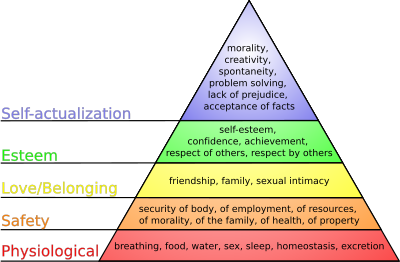
I agree with the the latter argument, because of Maslow's Heirarchy of Needs, (which I agree with), which would show that she's giving up self-actualization/esteem/love+belonging in the long run for physiological in the short run.

At any rate, what this discussion proved to me is that there is no one definition as to what is sexist and what isn't sexist, and that things that are seen as empowerment from one angle can actually be demeaning from another angle.

I discussed hard and soft racism in the last post, and you can basically substitute hard and soft sexism (or hard and soft homophobia) here. Hard sexism is an ideology that women are inferior; soft sexism is an attitude or action which demonstrates negative attitudes or associations with regard to women.

Since I covered this exhaustively in the last post, I'm just going to say something more briefly about hard/soft sexism: I believe Sarah Palin's nomination is soft sexism.

The reason is this: there are many, many qualified women in this country. Even among Republicans. Kate Fiorina, the CEO of HP. Condoleeza Rice (since apparently Bush's policy isn't discredited, as I had previously thought). Senator Olympia Snow. A controversial pick might be Democratic governor Cathleen Selebius, who I had considered a possible candidate for Obama's political ticket.

But even if Sarah Palin was the best woman that could have been chosen, she would have had to be vetted. The fact that McCain waltzed in, decided to pick a woman he'd spoken to once as his VP, and assumed that this would endear him to the women of the country is insulting. And that's what I mean by soft racism. I don't think McCain thinks women are inherently bad. But he clearly doesn't take them seriously enough.

Thursday, September 11, 2008

Identity Politics

Today, in my Culture of Dissent class (taught by the inimitable Jan Urban, a Czech dissident from the Velvet Revolution and an excellent journalist in Bosnia, and Kosovo), we discussed the rather difficult question of why Communism proved to be popular.

The answer, from my point of view, is one having to do with the nature of identity in the 20th Century. There are many people who don't believe themselves to be very philosophical in their everyday life (philosophy being a very 'elite' passtime), but in point of fact, everyone has philosophical ideas and worldviews. And one of the big philosophical questions is, "Who am I? What is my identity?"

People base a surprising amount of their political convictions and idealisms based on who they think they are. For instance, one of the reasons that Americans have consistently voted for tax cuts for the wealthy is an array of polls which show that Americans consistently think that they are wealthier than they actually are (which corresponds to the way that they think they're thinner than they actually are).

We talked about the appeal of communism in the Industrial Revolution era. In order to understand it, you need to take a village-eye view of the change. The poor serfs, living in small rural communities, lived in an era with very little mobility. They were engaged in occupations passed down to them from generations, among a small community of people they knew. As the industrial revolution came to pass, serfdom was abolished: they were not necessary anymore. A vacuum formed, which sucked these serfs into the city. Suddenly they were in a huge community, much larger than themselves. Whatever they had previously been known for, through their family, was no longer a mark of identity. They passed by nameless and faceless masses everyday; they worked alongside nameless and faceless masses that did exactly what they did. There was no honor in their new work: they were (proverbially) just another cog in the machine; just another brick in the wall. They had been robbed of their identity, their purpose, and their security.

It was rather like going to a large college after being in a small high school.

At any rate, they needed a new identity. Communism provided that. It gave them a name for themselves: proletariat. It gave them a cause for their misery: bourgoisie. It told them that not only were the proletariat powerful, they were the single most powerful force of history: and that it was historically determined that they must succeed.

So, to turn to contemporary politics: during the Cold War, these identity politics broke apart into large dualisms: Communists and Capitalists on the world stage, and Democrats and Republicans on the American stage (note that third parties were still a noticeable force until World War Two). Ideology became, for one of the few times in American history, a primary source of identification: Democrats, Reds, Anti-Communists, Republicans, Socialists, Peaceniks, Hippies. All of these tags were ideological in nature. They gave people a sense of identity.

Today, these two grand coalitions seem more fractured. At least, the Republican camp seems to have split decisively into moderates, libertarians, neoconservatives, and social conservatives. A messy primary season filled with candidates who did not fully appeal to any of these groups (with the exception of Mike Huckabee for social conservatives and the Ron Paul movement for Libertarians) left people on the right with a lack of a sense of direction. Many of these people identified themselves as Republican strongly, without being on board with many of the actions or beliefs of other Republicans.

A big tip-off to me that this identity politics is coming apart? Obama has a large following of so-called Obamicans (Republicans for Obama). Notice, of course, that they are still calling themselves Republicans despite voting for Obama. I'm not necessarily saying that they aren't actually Republicans, but I'm noticing that their insistence is on defining themselves by a party affiliation which, in this election, may not be entirely accurate.

One of my favorite sayings to hear is "I've been a life-long Republican, but I'm considering voting Democrat." Notice the phrase "life-long." This is put forward as a positive, even though being a life-long Republican might imply that you've supported characters like George W. Bush, Nixon, or Reagan (in the same way that a life-long Democrat must have supported Carter, Dukakis, McGovern).

But this is the way people have previously identified themselves.

But with a hyper-specification of polls, there is a new level of identification going on. We hear it today on the news all the time. Demographics. Very small clusters of identity. How are middle-aged women going to vote? What about older men? Young black men in rural towns? These statistics can all be coallated. And apparently, they matter. And although women's groups have been condemning Palin since she was first put on the ticket, the latest poll shows that McCain has indeed spiked among women.

The question, I suppose, is whether we can move past identity politics. Barack Obama (in my opinion) has a way of addressing that. He appeals to people to vote not as Democrats, or Republicans, or as black and whites, but as Americans. This isn't just a trite slogan of identification: he's asking us to identify ourselves as America, and vote in such a way that doesn't just benefit my group or your group or any group, but benefits all of America.

And the question is: will it work.