Tuesday, May 31, 2011

RESPONSE: Memorial Day

But for the earliest and most remarkable Memorial Day, we must return to where the war began. By the spring of 1865, after a long siege and prolonged bombardment, the beautiful port city of Charleston, S.C., lay in ruin and occupied by Union troops. Among the first soldiers to enter and march up Meeting Street singing liberation songs was the 21st United States Colored Infantry; their commander accepted the city's official surrender. Whites had largely abandoned the city, but thousands of blacks, mostly former slaves, had remained, and they conducted a series of commemorations to declare their sense of the meaning of the war.

The largest of these events, forgotten until I had some extraordinary luck in an archive at Harvard, took place on May 1, 1865. During the final year of the war, the Confederates had converted the city's Washington Race Course and Jockey Club into an outdoor prison. Union captives were kept in horrible conditions in the interior of the track; at least 257 died of disease and were hastily buried in a mass grave behind the grandstand. After the Confederate evacuation of Charleston black workmen went to the site, reburied the Union dead properly, and built a high fence around the cemetery.

They whitewashed the fence and built an archway over an entrance on which they inscribed the words, "Martyrs of the Race Course." The symbolic power of this Low Country planter aristocracy's bastion was not lost on the freedpeople, who then, in cooperation with white missionaries and teachers, staged a parade of 10,000 on the track. A New York Tribune correspondent witnessed the event, describing "a procession of friends and mourners as South Carolina and the United States never saw before." The procession was led by 3,000 black schoolchildren carrying armloads of roses and singing the Union marching song "John Brown's Body." Several hundred black women followed with baskets of flowers, wreaths and crosses.
Sometimes the facts do all the talking.

NEWS: If You Were Surprised...

If you were surprised by Arnold Schwarzenegger's post-Gubernatorial revelations, you weren't paying attention:


I hear that criticism leveled more towards the French regarding Dominique Strauss-Kahn.

Monday, May 30, 2011

PRAGMATIC: Dedication to Silliness

I'm the sort of person who thinks culture should be very practical, should really move people forward or give them something that they didn't have before; I think that culture is how we increase ourselves or the world around us.

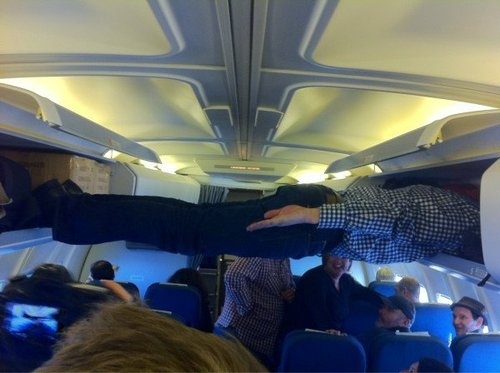
And then there's Planking. That's right, Planking:
Planking is the act of lying face down with arms to the sides of the body, in unusual public spaces and photographing it.
Planking:


And more planking:


I can't explain exactly why it brings me so much joy to see this dedication to silliness. I mean, it's easy to just be silly a little bit, but it's damn hard to be this incredibly silly. Someone has died over this. People go out of their way to do it in sillier and crazier ways. There's no stopping it. It's a worldwide force for uselessness.

I can't pretend I know why we have this deep vein of silliness. I like to think it's the real antidote to Bin Laden or Ratko Mladic. Silliness like a cruise missile.

Saturday, May 28, 2011

ARTS NEWS: Kansas Loses the Arts Commission

Governor Brownback (yes, that former Senator Brownback) has vetoed the Kansas Arts Commission. For full coverage, tune in to Createquity's post on the subject.

There isn't much to say beyond the obvious: the people of Kansas -- all of them -- are worse off because of this. As ARTSBlog points out, it's the first state without an arts agency, and by extension that the first time a Republican government has successfully achieved their goal: they've divested any responsibility over investment in culture.

There's one aspect of cultural policy which is "how much should the government invest" and "how should the government go about investing it. Another aspect is, "Should the government be involved in cultural policy?"

Kansas is now the first state to answer that question with "No."

UPDATE: Barry weighs in with rage and sorrow:
It is you and I, as individuals, who did not make those $20 checks out to local advocacy organizations. Oh we meant to didn’t we? But we didn’t do it. It is those performance and exhibition based arts organizations who didn’t join those same advocacy groups and who didn’t (and won’t) hold benefit performances or exhibitions for that effort. It is those larger cultural organizations who see too little in it for themselves and for whom the whole of the sector simply isn't a big enough priority. It is all those foundations that have refused to fund advocacy efforts – even as benign as modest efforts to train our core in how to advocate – pretending, ever so conveniently, that they were legally prohibited from engaging in anything that smacked of politics (an absolute falsehood and simply not fact), and their timidity is partly to blame -- much as we are for clinging to the lie that we cannot lobby, and cannot support candidates with money (we can legally do both if we just set up the right structure and follow the simple rules). Let me just shout that again out loud in the winsome hope that it will finally get through - because some of you just refuse to accept the law - WE CAN LEGALLY LOBBY and SUPPORT CANIDATES WITH MONEY. YES we can - [not as 501 (c) (3)s, but as 501 (c) (4)s and PACs!] Of course you have to be careful and judicious how you exploit this kind of power on your behalf - but how you use power is a different question than amassing it to begin with.

ARTS ECONOMICS: He's A Faliure! (cont'd)

On the heels of Tony Kushner admitting he's not able to support himself as a playwright, another blow to the creative lifestyle:
When Tyler Cowen was 15, he became the New Jersey Open Chess Champion, at the time the youngest ever. At around the same age, he began reading seriously in the social sciences; he preferred philosophy. By 16 he had reached a chess rating of 2350, which today would put him close to the top 100 in the U.S. Shortly thereafter he gave up chess and philosophy for the same reason: little stability and poor benefits.
My god... if our nation's chess champions can't support themselves...

(P.S. If you're not detecting the tongue-in-cheek, I've got a tumblr you'd love.)

PERSONAL: It's Over 900!

Yeah, over 900 posts. Thanks for reading some of them.

Friday, May 27, 2011

ORANGE HATS: An Interview with our Founder / Format Experiment

A little late to the link, but here's a feature on Ben Lundberg, and the Orange Hats. It's a good overview of who we are and what we do. Here's a taste:

As far as larger experiential observations, Lundberg noted: "I don't think I would have become as interested in this project if I wasn't inherently somebody who engaged in criticism a lot." Because of the fact that he archives others' responses immediately after a performance, Lundberg does not get to engage with his own feelings. "What's interesting," he said, "is that it gives me at least twenty minutes of pause where I'm not obsessed with what I think about a show, where that's not my main focus. I have to listen to [others' responses], because we ask questions...because we're trying to open a conversation, so I really have to be part of that conversation, even though I'm a silent part."


Also, Ben is trying out a new format for Blessed Unrest's ArtCamp SexyTime FootBall. In addition to our usual edited video, he has released the raw interviews (divided person-by-person) shot during the evening. I'd love to hear what people think of the difference between the edited video and the raw video; comments here or there!