Wednesday, February 16, 2011

Supply/Demand cont'd (A Response)

The response to the 'Don't Start A Theater Company' is 'I'm Starting My Theater Company, Damn It'. As someone in the same camp... kudos!

I actually asked the head of my college about this today, in passing, and all she had to say was, "They're just threatened. Then again, everyone's threatened."

Tuesday, February 15, 2011

The NEA pt 3: Can You See Me Now?

Can you see us in this budget? I didn't think so.

Supply/Demand

The true face of the "Supply/Demand" talking is really this: the "Please Don't Start A Theater Company" talking point.

The NEA pt 2: Your NEA

Tell us about a project–or multiple projects–that enriched your community, projects that would not have been possible without support from the NEA.

Use the comments here and, if you’re on Twitter, take a moment and post there using the hashtag #NEA365.
Here's my problem... I'm not sure if I can contribute. I can't think of an institution that I visited in the last year that had an NEA logo on a program. I could put up TCG, but I'm not sure they've reached me ever. And certainly I'm not sure any of these projects would not have been possible without the NEA. The only time I ever heard the NEA's funding referenced by a recipient was someone derisively noting that the NEA's funding is nice to have, but not significant in their budget.

How We Make Our Case II

Isaac asks another important question:
I know there are quite a few people from the arts advocacy and funding sector who read this blog, so I have to ask: are there studies out there that can tell us whether Drum is right? Has anyone reliable gamed out what the potential impact of doing away with charitable deductions would be? Because I think this is the kind of scenario where data is really going to drive the argument.
No clue what the answer is.

However. I do have to point out that there's another comparable deduction, which is the deductions of losses for small business owners.

I, as a small business owner, have the right to deduct any losses I take after my profits from my income, if I make an income from a different source. In other words, I could donate to charity, or I could invest income into my business, and it is equivalent in terms of tax deduction terms. (And it runs into similar skepticism -- see "Proving Your Hobby Is A Business")

The reason I bring this up is because if we proposed taking away that tax deduction, you would never the end of it. What's the economic case for that tax deduction? Because it's based on the same theory -- allowing people to deduct their "losses" (a donation being a "loss" from an individual capitalist perspective, as you are giving money for nothing in return) to further a social goal (building the economy, or building culture/education/literacy).

Don't Save the NEA - Replace It?


In practical terms, he's absolutely rights. In writing How We Make Our Case, I realized that the NEA and CPB are probably the smallest things our government does to bolster the arts; the biggest thing (at least, that are arts-specific) is the donation tax deduction for the arts.

But the GOP attempt to destroy the NEA is not merely about that practical support. It's also incredibly symbolic. Once the NEA goes, there is no part of our government that is even nominally responsible for supporting the arts. Sure, we'll be part of the Department of Education, and part of the State Department, and part of a thousand other projects, but once the NEA is gone, it won't be anyone's job to even try to look out for us.

However much flak Rocco Landesman has gotten for his remarks, I think we can all agree that the reason they're a firestorm is because he's one of the few people who gets to take the arts to Washington. He's the person who's supposed to be championing us in Washington. I'm not convinced he's doing a great job of that aspect.

So while I agree completely with the many of the points Don Hall makes (and disagree with others, but that's a different post), at the core, I think that something called the NEA -- or some sort of successor -- needs to survive. If only to remind the American people that there's something called the arts in this country.

And, lastly, if we want something called the NEA or some successor to survive in American culture, it had better start doing its job better.

Monday, February 14, 2011

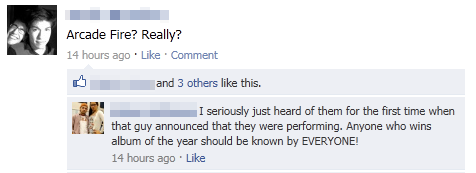
Who Is Arcade Fire?

The "Who is Arcade Fire" tumblr is not just an amusing diversion for those hipsters who still enjoy sneering at people who haven't heard of their favorite bands (yes, I realize Arcade Fire is pretty damn popular in one genre but until last night they didn't cross over into the radar of people living in areas without vibrant indie scenes).

But the one I nabbed before makes an interesting claim: how can the "best album of the year" not have been "known by everyone"?

POINT 1: QUALITY AND THE MAIN STREAM

There is an underlying assumption that persists in our culture that if you make something of very high quality, it will enter the main stream. With the internet, it certainly increases the idea that "If it's so good, why haven't I heard of it?" because we assume that someone would have linked it to us before.

The post I wrote earlier today, about Kevin Drum's objections to arts funding, touched on a similar point. Considering as we have no lack of distribution media for music, and Arcade Fire is considered a quality band (not just by the Grammy's, but by a lot of people and people inside the music industry), how could people not have heard of them?

Whereas, on the flip side, I don't like Lady Gaga's music all that much (although I do respect what she's done, and I think the performative aspect of it all is fascinating). But try as hard as I could (I did actively avoid finding out who Lady Gaga was), I found out about her. The same bridge was finally crossed for me when Justin Beiber got to do a quick little segment on The Daily Show. Justin's shrewd distributors had gotten someone from circles I don't inhabit in front of my face.

I'm curious why it took so long for Arcade Fire to do the same?

POINT 2: AWARDS, BEFORE OR AFTER?

When Obama wins the Nobel Peace Prize before really making any significant worldwide peace contributions (yeah, he did some work on nuclear non-proliferation, but the treaty wasn't ratified until this past December, which was quite a while after his award).

However, the Grammy's I think did a good thing by choosing to honor artists who still have audiences to conquer (both Arcade Fire and Esparanza Spalding).

Should an award greet you after the finish line, or should it boost those who have proven their mettle, to help boost their ability to fulfill their potential?