Wednesday, November 17, 2010

Tuesday, November 16, 2010

Wasserstein

So, if you don't know, the Wasserstein Award goes to emerging female playwrights for outstanding work. It's a big hefty prize. One problem: this year, they decided not to award it to anyone.

I find it completely plausible that the panel were faced with four finalists that they didn't really feel enthused about, and decided not to award it to any of them.

At that point in the decision-making process, I could agree with them not awarding the prize. But what they missed was a chance to ask why they didn't have good candidates in front of them.

Clearly, it's practically inconceivable that in the United States today there is not a single female playwright who's emerging who's worth the prize. I think the general wide-spread outcry shows that most people agree with that fact.

So if we can agree that probably someone out there should have gotten the prize, then the question is, why weren't they in the finalists?

That's the question that the Wasserstein Award people should be asking themselves. How have they failed the community so badly that with a $25k award, they still couldn't give it to anyone?

I did a report for Createquity on "The Search for Shining Eyes", a report about the Knight Foundation's Magic of Music Symphony Orchestra Initiative. They were looking for some orchestras to honor with massive amounts of money. After the first round, they looked at their applicants, and realized they didn't have the applications they wanted.

What did they do? They started over. They basically said, "If we don't feel good about these applicants, it's because we screwed up our process. Let's fix this." And they did. And then they got applicants they liked much better."

So, Wasserstein: it seems to me that the worst thing you could do right now is just give that money to one of the four finalists you previously rejected. It will just read, "Oh, well, we think she's crap, but you all were angry so we gave her the cash anyways." For my money, you should figure out what the problem was, and take a stab and fixing it -- even if that means starting over. Those same finalists should be given the opportunity to prove that they were actually worth it, but you should keep re-doing the process until you find that person who you actually feel is worthy of the prize.

They're out there, I know. I've worked with them.

"Pop" Language


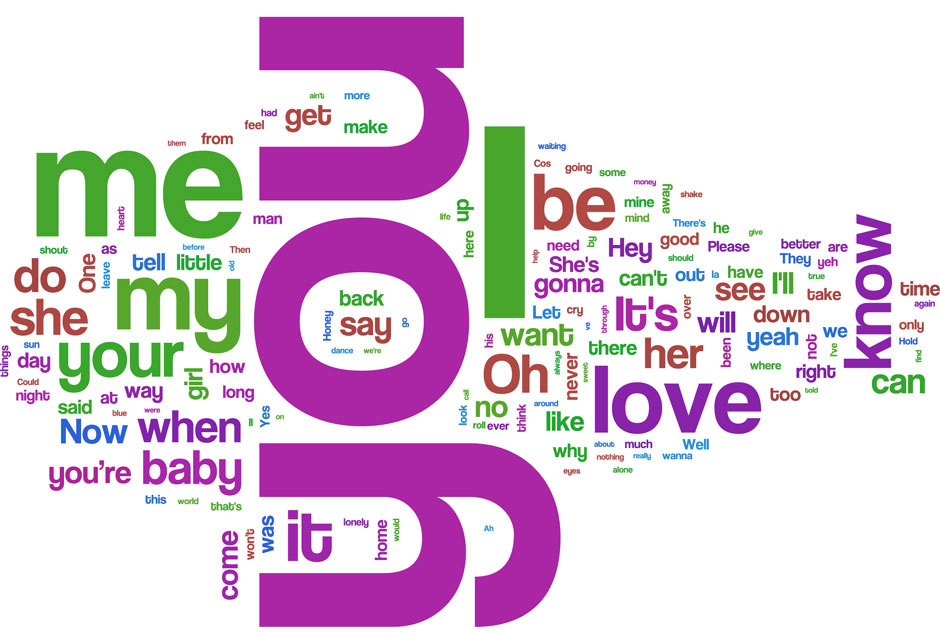
That's the word cloud of the lyrics of Beatles song.

Almost instantly you can see one of the keys of their success: universally recognizable English. Seriously, if you look at the lyrics of many of their songs ("Come Together"?), they use very simple English with words that can carry a lot of emotional freight.

And look at those pronouns! I have had many a Shakespeare teacher talking about how you never emphasize the personal pronouns; here, the Beatles are basically singing about the listener, singing about themselves, and singing about that relationship ("Want" "Tell" "Do" etc.).

Sunday, November 14, 2010

Quote of the Day

As for its sensuality,–& it may turn out to be less sensual than it appeared–I do not so much wish that those parts were not written, as that men & women were so pure that they could read them without harm, that is, without understanding them. ...Of course Walt Whitman can communicate to us no experience, and if we are shocked, whose experience is it that we are reminded of?

Friday, November 12, 2010

Punchdrunk's Stella Artois Gig

Here's the scoop: England is facing massive, massive budget cuts across the board, including to the arts. In this atmosphere, Punchdrunk (a British theater company) is doing a performance commissioned by Stella Artois to promote a new beer:

Here's the surprise. The project has been put together by none other than Punchdrunk, the theatre company famous for – among much else – 2007's The Masque of the Red Death and this summer's ENOcollaboration, The Duchess of Malfi. The company has done this sort of work before – most recently at the glitzy launch of Louis Vuitton's Bond Street shop earlier this year – but the blatantly commercial nature of this Stella project throws up questions about whether it's right for theatre companies to do such corporate gigs at all.

But, then, The Night Chauffeur isn't claiming to be a Punchdrunkproduction – the company's name isn't on the marketing material for the lager launch and there's no mention of the event on the theatre company's website. In fact it wasn't easy to track down someone from the company to clarify what their contribution to the project actually was – I was initially told they weren't doing any interviews at all – but when I did, executive director Colin Marsh was keen to stress that The Night Chauffeur is not a Punchdrunk show, but a piece of work the company has created in collaboration with Stella and the advertising agency, Mother. This is Stella's event, not Punchdrunk's, he argued – even though the same creative team is involved. It's intriguing if slightly baffling explanation, especially given that they have previously spoken out in favour of doing commercial work.

The sad part is that my first response was jealousy: the British have always had more public funding than we've had -- now they're doing better than us at corporate support?

But really, this is just a symbol of the relationship the arts have today with alcohol. I've joked about it before, but the young theater companies I know are basically in the debt of the alcohol industry. We get people to come to our fundraisers through the lure of alcohol, among other things.

Right now, one of my company's projects is to try and build a relationship with an alcohol distributor, to see if we can get discounts on alcohol for fundraising purposes. And this is not an uncommon thing. One of my favorite art groups, Fresh Ground Pepper, has kept its commitment to not charging tickets largely through its sale of alcohol -- and here I am jealous that they've got the hook-up!

So in a way, it's refreshing to see Punchdrunk dive full in to alcohol patronage. If Stella Artois or Sixpoint Brewery want to patronize the arts, let them! It's nice to hear a company think that art could benefit them. Most companies wouldn't want to be associated with theater if it was dead. Stella Artois might be getting some brand association with Punchdrunk, but Punchdrunk is getting some brand association from Stella Artois as well.

And what has a better brand, theater or alcohol?

Legal Commentary: Twitter Joke Trial

News from England: young man who made a joke on Twitter about blowing up a small airport while flirting with a young lady has lost his appeal.

Here's a run-down on why the joke, though dumb, should not have been considered "menacing" and therefore an offense.

Thursday, November 11, 2010

Review: The Magic Flute

TARGET MARGIN THEATER LAB
at the Brick
THE MAGIC FLUTE
upcoming performances:
Thursday through Saturday at 8PM
Sunday at 7 PM

I've already sung Kate Marvin's paean's once, but it's time for me to do it again. As part of Target Margin Theater's Laboratory, Kate has directed (I believe for the first time?) Mozart's Magic Flute. And you should go see it.

WHAT HAPPENED?
Ah jeez. Usually this is the easy part where I reduce the show I've seen to some easily followed description. Really, what this Magic Flute was was a lot of genius put in a box and shaken up. Like a crash box. Was it an operatic sketch show, with a series of musical gags and dance comedy performances? Was it a free-association dream of what Mozart's opera could be if you did it today?

I really don't have any idea. Which brings me to my next point:

I REALLY DON'T HAVE ANY IDEA
The great thing about this Magic Flute is that it is so damn entertaining and moving that you're free to not know. Particularly for me, with my "Pragmatism" and my "Critical Analysis" and my needing to know things about theater, I've gotten used to understanding everything. It's incredible hubris, and I'm incredibly thankful that I was given the opportunity to let go.

IT WAS HILARIOUS
John Kurzynowski carries the comedic show on his back. Whether he's hamming up a German accent or silently and seriously riding It's A Small World with Disney Land ears, you can just watch him pour every bit of his soul into making you laugh. Whether it's an over-the-top hilarious sketch, or just a tiny detail -- someone "tuning" a bottle full of water at the top of the show -- the hilarity is heightened because there's no warning, it side-swipes you when you're not looking for it.

IT WAS BEAUTIFUL
But the hilarity was there really to buy your presence, to set up a world so that it could be stripped away. By the end, the theater itself is drained away and it only leaves the beauty of Kate Marvin and Diana Konopka's musico-auditory experience, and the simple and stunning visual lighting design of Natalie Robin.

NO, SERIOUSLY, WHAT HAPPENED?
I should probably be writing a more coherent review, but honestly I don't know how coherent my experience was. Somewhere towards the end, when there was nothing but a beautiful sea of lights and the musico-auditory experience, I nearly burst into tears. I have no idea why or how. It was a beautiful dream of music, and I followed it and lived it wholly. It broke me on a level I don't understand.

ALL I CAN TELL YOU IS THIS
You need to go see it and hear it for yourself. I was left more than speechless, I was wordless. I had nothing but pure experience. And it may be the first time that I understood what Opera used to mean.

(Disclaimer: Hey, guess what FCC? I paid for my own damn tickets this time!)