Friday, May 27, 2011

ARTS IN MAINSTREAM: The Economist's Narrative Needs

I love this line in an op-ed by The Economist:

The worthwhile, boring, essential parts of war and life do not make good television. They do not even make good narrative: David Foster Wallace's posthumous novel tries to sanctify boredom (and if I ever manage to slog my way past page 56 I'll let you know if it succeeds; he's a great writer, but come on, I'm only human, I have my narrative needs too), but otherwise writers and filmmakers wisely steer clear of the subject.


I think that's a pretty good summation of the average open-minded person's relationship to narrative. Non-narrative can be good, but it's also hard, and sometimes people have needs.

P.S. I also really love the Economist website's trending topics visualization.

ARTS ECONOMICS: Pay What You Can Dining!

Alright, it's the culinary arts, but here's what Panera is doing:

After a year, Panera Bread's experiment with "pay what you can" restaurants seems to be working. The cafe chain now has three locations using the donations-only model (Clayton, Mo., Dearborn, Mich., and Portland, Ore.), out of its nearly 1,500 locations nationwide.

(...)

Most patrons, it finds, drop the entire retail cost, or more, into the voluntary donation box, in essence subsidizing a meal for someone who can't pay the full amount. Panera says about 60 percent leave the suggested amount; 20 percent leave more; and 20 percent leave less. The largest single payment so far? One person paid $500 for a meal.

Two important things to note, before you run off and try this yourself:
  • Most people pay the retail cost because, I would guess, they know what the suggested price is and know that it's within reason.
  • The person who paid $500 probably did so because he felt like this was an important venture, and he wanted to cast a big vote for it succeeding. The more saturated your market is the less likely someone will feel that compulsion.

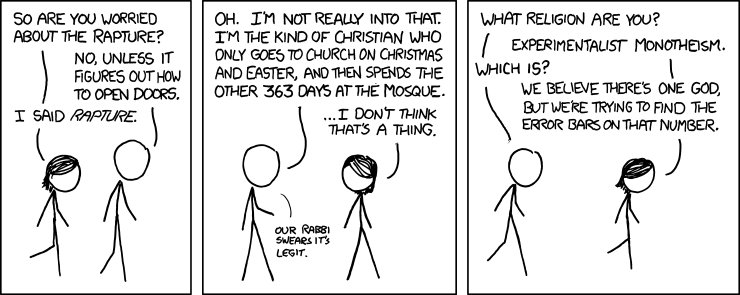
RESPONSE: Error Bars

This is basically how I explain "Experimental Theater":

PRAGMATIC: The Future of Art in the Web

Artist Aaron Koblin gives a great TED Talk overviewing his use of web design and collaborative digital spaces as art:


It's important as the internet moves forward that the people who invest in building the platforms people inhabit digitally continue to invest time and effort into thinking about the aesthetic aspect of their work, in terms of creating homes for culture.

What I find heartening about Koblin's talk is not just that he was able to create great things himself, or that he was able to exploit platforms like Amazon's Mechanical Turk, but that a company like Google invested time-- across multiple teams. Hope for the culture of creativity.

Thursday, May 26, 2011

GLOBAL NEWS: Moving Slowly Towards Justice

It's slowly coming to an end:

PARIS — Ratko Mladic, the former Bosnian Serb general accused of war crimes including masterminding the massacre of some 8,000 Muslim men and boys at Srebrenica in 1995, has been captured in Serbia after more than 15 years as one of the world’s most wanted fugitives.


This is three years after the government of President Tadic, shortly after their election, captured Radovan Karadžić:

Karadžić had been hiding disguised under the alias Dr. Dragan David Dabić (Драган Давид Дабић) offering his services as a doctor of alternative medicine under the company name of "Human Quantum Energy".


Even more than Bin Laden, Karadžić was hiding in plain sight in the country's capital. But when a pro-EU government rose to power, he was found and sent to the Hague, and now Ratko Mladic is following him.

Wednesday, May 25, 2011

ARTS ECONOMICS: Tony Kushner Is A Failure!

I mean, not from an artistic standpoint. But here's what he has to say about his personal economics:

I make my living now as a screenwriter! Which I’m surprised and horrified to find myself saying, but I don’t think I can support myself as a playwright at this point. I don’t think anybody does.


(h/t Playgoer)

ART NEWS: Adding Insult To Injury

Time Out Chicago brings us this update from the Netherlands;

You might call Czech artist Jirí Kylián the Christopher Nolan of dance: Only an infrastructure developed over a century (the state-supported European concert-dance system, or “dance’s Hollywood,” as I’ll call it) allows him to create as big as he thinks (dances such as Bella Figura and 27'52" are akin to The Dark Knight and Inception).

In this analogy, the world-renowned Nederlands Dans Theater, based in the Hague and Kylián’s artistic home for more than three decades, would be Warner Bros.

It faces an uncertain future: The cultural council of Holland recently proposed cuts of up to half its annual budget. (The Dutch National Ballet, the country’s largest dance company, faces a 26-percent amputation.)

(...)

NDT may also be downgraded to “regional amenity” status. Its tours to Buenos Aires, Chicago, Melbourne and other cities, where fans fill the largest opera houses available, would take a back seat to appearances in Dutch suburbs such as Rijswijk, Voorburg and Wassenaar.


Well, if you need an up-to-date reason not to want arts to be directly controlled by governments, that seems like a pretty good indication as to why.

The political calculus is plain to see: the country is paying for art which is (ostensibly) being consumed more overseas than by its own rural citizens. It seems as though previously, the group had an unquestioned role in bringing Dutch art overseas; now, the politics is pushing them to focus on their own people.

The article's author, Zachary Whittenburg, does make a bold claim:

Dance without the boundary-pushing creations made in Europe would be like film without Hollywood.


Is Hollywood good for film?